Share



Published on 13 February, 2016
| Last Updated on 29 July, 2026
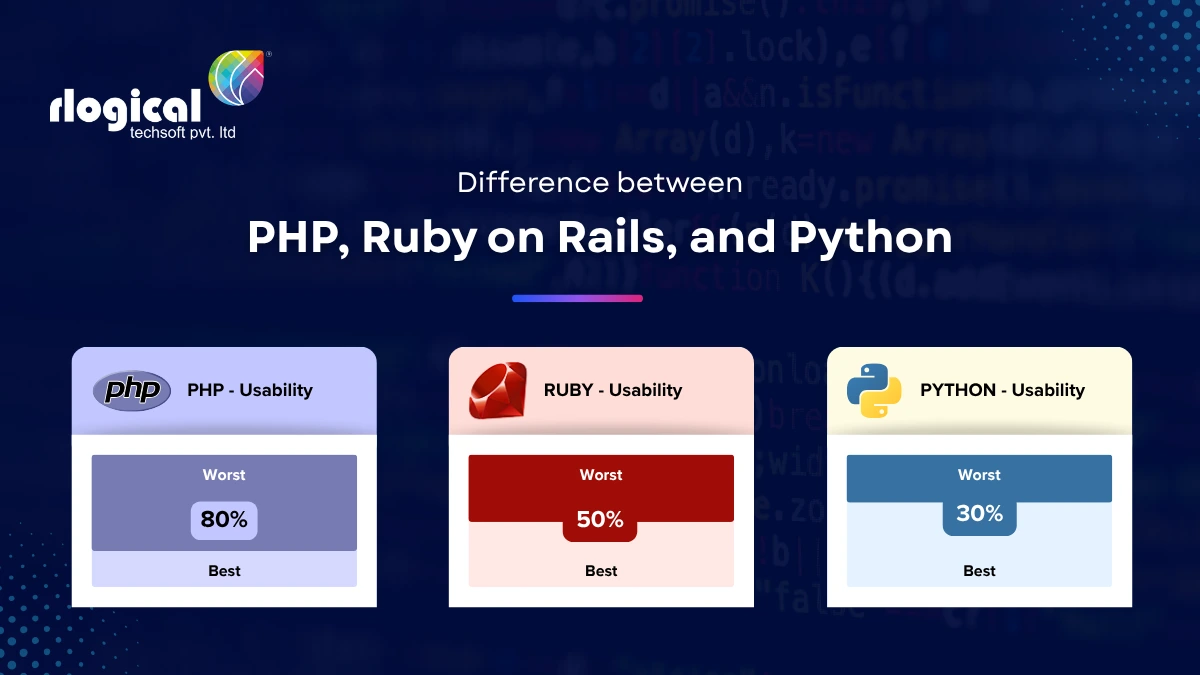
Picking a backend technology today is no longer just a question of syntax preferences or developer salaries. It is a strategic call that shapes hiring pipelines, deployment costs, AI integration paths, and how quickly your product reaches paying customers. Three names continue to dominate that decision for most product teams: PHP, Ruby on Rails, and Python.
All three have crossed the three decade mark. Each one has reinvented itself for the era of AI agents, edge deployment, and database backed background processing. This guide breaks down what they share, where they part ways, and which workloads each one genuinely wins in today’s stack.
| Parameter | PHP | Ruby on Rails | Python |
| First released | 1994 | 2004 (Rails framework) | 1991 |
| Latest stable major release | PHP 8.5 | Rails 8.1 with Ruby 4.0 | Python 3.14 |
| Type | Server side scripting language | Full stack framework on Ruby | General purpose programming language |
| Primary paradigm | Multi paradigm, OOP heavy in 8.x | Object oriented, MVC, convention over configuration | Multi paradigm with strong OOP support |
| Typical use case | Content sites, ecommerce, CMS | SaaS products, MVPs, startups | AI, data science, web apps, automation |
| Headline frameworks | Laravel, Symfony, CodeIgniter | Rails (the framework itself) | Django, FastAPI, Flask |
| Job market presence | Massive, slowly maturing | Niche but well paid | Largest and still growing |
PHP was born in 1994 when Rasmus Lerdorf wrote a set of CGI scripts to track visits to his online resume. What started as Personal Home Page Tools became the engine behind WordPress, Wikipedia, Facebook’s early years, and a huge portion of the web’s CMS layer. Modern PHP looks almost nothing like its 2010 self. The Zend engine, the JIT compiler introduced in PHP 8.0, named arguments, enumerations, readonly classes, property hooks in 8.4, and the pipe operator in 8.5 have turned it into a fast, strongly typed, expressive language.
Ruby itself was created in Japan by Yukihiro Matsumoto in 1995, but it stayed relatively obscure outside Asia until David Heinemeier Hansson extracted Rails from Basecamp in 2004. Rails introduced the world to convention over configuration, the DRY principle in practice, and scaffolding that let a solo founder ship a real product in a weekend. Its philosophy has never really changed, and Rails 8 doubles down on it by replacing Redis dependencies with database backed solutions and bundling deployment tooling out of the box.
Guido van Rossum released Python in 1991 with one stubborn idea: code is read more often than it is written. That commitment to readability, combined with a standard library that genuinely tries to include the kitchen sink, made Python the default language for scientists, data engineers, and now every team building on top of large language models. Its web frameworks, Django and FastAPI in particular, have ridden that wave into mainstream backend work.
Despite very different cultures, the three share a surprising amount of DNA.
Python wins the readability contest by a wide margin. Indentation as syntax forces a clean visual structure, and the language reads almost like pseudocode to newcomers.
Ruby trades raw clarity for elegance. Blocks, symbols, and metaprogramming let experienced developers write expressive one liners, but the same features can confuse someone coming from Java or PHP.
PHP, especially in its 8.x form, has caught up significantly. Modern PHP with strict types, enums, and named arguments is a genuinely pleasant language. That said, the legacy global function namespace and inconsistent naming from older versions still leak into tutorials, which can frustrate new learners.
PHP 8.x with OPcache and JIT is fast for traditional request response workloads. It excels at the classic pattern of read database, render template, return HTML.
Python is generally slower than PHP for raw web serving but runs ahead in CPU bound, numeric, and AI inference work where libraries like NumPy, PyTorch, and Polars push heavy lifting into native code.
Ruby has historically been the slowest of the three. That gap has narrowed dramatically since Ruby 3.x introduced YJIT, and Ruby 4.0 added the experimental ZJIT compiler aimed at higher long term performance ceilings. For most web workloads Rails throughput is comfortably good enough, and frameworks like Hotwire reduce the need for performance heavy frontend round trips.
PHP scales horizontally with ease because each request is stateless by default and the deployment model fits naturally into shared hosting, containers, or serverless functions.
Python scales well in microservices and async architectures, especially using FastAPI with ASGI or Django with Daphne.
Rails 8 introduced what the community calls the Solid Trifecta, which is Solid Queue for background jobs, Solid Cache for caching, and Solid Cable for websockets. Together they replace Redis with database backed alternatives, simplifying infrastructure for small and mid sized apps while still scaling to high job throughput in production at companies like Basecamp and HEY.
Python is the easiest to pick up. PHP comes second, particularly if you already know any C family language. Rails has the steepest curve because you are learning Ruby, the framework conventions, ActiveRecord, and the broader ecosystem all at once. The reward is that once Rails clicks, productivity is exceptional.
Python developer demand is the strongest of the three by raw volume, fueled by the AI and data engineering boom.
PHP still powers a huge installed base, including most of the world’s WordPress, Drupal, Magento, and Shopify storefront layers. Demand is steady and there are typically more PHP positions than Rails positions in any given market.
Rails roles are fewer in number but tend to command higher than average salaries in mature markets like the United States. Companies like Shopify, GitHub, and Stripe continue to invest heavily in Ruby infrastructure, which keeps senior Rails work in demand.
PHP is famously simple to deploy. Drop the files on a LAMP or LEMP server and they run.
Python applications usually need a WSGI or ASGI server such as Gunicorn or Uvicorn, plus a process manager and a reverse proxy.
Rails 8 ships with Kamal 2 as the default deployment tool, which generates Docker configuration automatically and supports TLS and HTTP/2 out of the box. This closes much of the historical deployment complexity gap between Rails and PHP.
This is the section that separates a stale comparison from a current one.
The pipe operator introduced in PHP 8.5 lets you chain function calls left to right in a clean, functional style. Combined with property hooks from 8.4 and the maturing JIT, modern PHP feels closer to a strongly typed functional friendly language than the spaghetti template engine it was once mocked for. PHP 8.5 also added a built in URI extension, clone with property overrides, and improved fatal error backtraces.
Ruby 4.0 shipped with ZJIT, the next generation just in time compiler aimed at larger compilation units than the existing YJIT. Rails 8.1 added Active Job Continuations that let long running jobs resume from a checkpoint after a deploy, native markdown rendering, and structured event reporting. The framework now feels remarkably aligned with how modern teams actually deploy software.
Python 3.14 made the free threaded build option officially supported rather than experimental, lifting the global interpreter lock for workloads that opt in. That single change unlocks parallel execution patterns that were impractical before. Combined with the dominance of frameworks like LangChain, LlamaIndex, FastAPI, and PyTorch, Python is now the de facto language for any backend that touches AI inference, embeddings, or vector databases.
There is one quiet trend worth noting. Convention over configuration frameworks like Rails tend to work especially well with AI coding assistants because the conventions reduce ambiguity. Python’s clean syntax and massive training corpus also make it a sweet spot for AI generated code. PHP, with the heavy adoption of Laravel patterns, benefits in the same way. If your team plans to lean on AI pair programming, all three are reasonable picks, but framework heavy stacks consistently produce better autocomplete results.
There is no universally best option. The right choice depends on what you are building, who is building it, and how fast it needs to ship.
Choose PHP, typically with Laravel, when you are building a content driven site, an ecommerce store, a SaaS dashboard with classic CRUD patterns, or anything that benefits from cheap, simple hosting and a deep talent pool.
Choose Ruby on Rails when you are a startup or product team that values speed to market above all else, when you have a small senior team that wants maximum leverage per engineer, or when you are building a feature rich web application with complex business logic.
Choose Python, typically with Django or FastAPI, when your product depends on AI, machine learning, or data heavy workflows, when you need a single language across web, scripting, and analytics, or when you are integrating with scientific computing libraries.
A growing number of teams use more than one. A common modern pattern is a Rails or Laravel monolith for the customer facing app, with a FastAPI service handling AI inference or data pipelines. Choose PHP, typically with Laravel, when you are building a content driven site, an ecommerce store, or any project where PHP web development offers cost-effective scaling and a deep talent pool.
Yes. PHP still powers the majority of websites with a known server side language, and modern PHP 8.x is a genuinely competitive language for new projects, particularly with Laravel.
No. Job count has plateaued and the TIOBE ranking has slipped, but real production usage at Shopify, GitHub, and thousands of profitable SaaS products tells a different story. Rails 8 and Ruby 4.0 represent meaningful technical investment, not a wind down.
Python, by a clear margin. PHP is second. Rails has the steepest learning curve but the strongest payoff once mastered.
Python. The library ecosystem is unmatched, and almost every major AI framework targets Python first.
For raw web serving, modern PHP with OPcache is hard to beat. For CPU heavy tasks, Python with native libraries usually wins. Ruby has caught up considerably with YJIT and the experimental ZJIT but remains slightly behind in pure benchmarks.
PHP, Ruby on Rails, and Python are not really competitors so much as different tools sharpened for different jobs. PHP keeps the web’s content layer running and has matured into a serious modern language. Rails remains one of the fastest ways to turn an idea into a working product when a small team is at the wheel. Python has become the connective tissue between traditional web development and the AI era.
The smart move is not to crown one as the winner but to understand what each one does well and pick the one whose strengths match the problem in front of you.
If you are still on the fence, prototype the core feature in two of them over a weekend. The friction or the joy you feel will tell you more than any comparison article ever co
Jatin Panchal is an innovation-driven entrepreneur, and the Founder & Managing Director of Rlogical Techsoft Pvt. Ltd. He believes modern leadership is driven by innovation, adaptability, and the transformative power of Artificial Intelligence. He focuses on helping businesses accelerate digital growth through AI-powered solutions, intelligent automation, Cloud, blockchain, IoT, and scalable enterprise technologies. With a strong strategic vision and future-focused mindset, he is passionate about building technology ecosystems that improve efficiency, drive innovation, and create long-term business value for global clients.
Global insights on technology trends, best practices, and digital transformation strategies.
A proven track record of high-impact deliveries across industries and technologies
Share with us. We'll assess its feasibility, suggest the right tech stack, and share a clear cost & timeline.
Years of Experience
Projects
Countries
Engineers
Verified Client Reviews
Industry Served