A Minimum Viable Product (MVP) is an initial software release containing core features designed to solve a specific problem for early users, validate market demand, and collect actionable feedback.
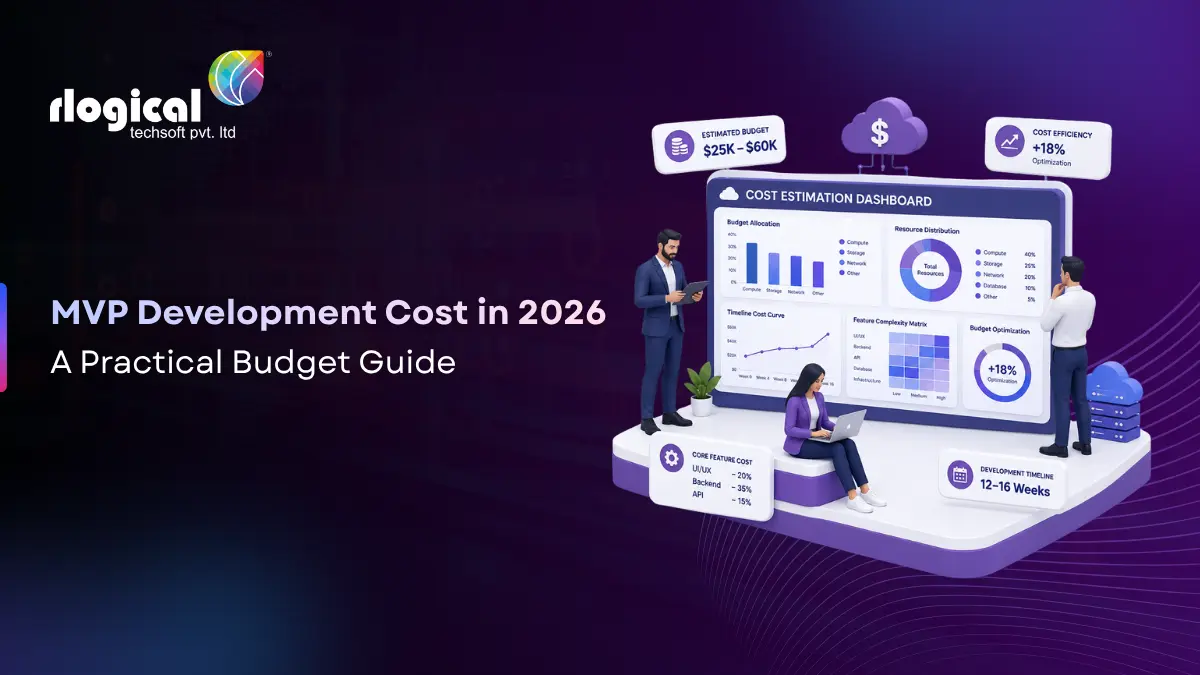
In 2026, building a custom software MVP typically costs between $15,000 and $75,000, while complex enterprise builds or advanced AI-driven applications range from $80,000 to $150,000+.
The actual cost depends on several factors, including feature complexity, platform requirements, backend architecture, third-party integrations, and team location. This guide details realistic budgets, development timelines, cost drivers, and practical strategies to optimize your investment.
Want to understand the complete MVP development process before planning your budget? Read our detailed guide: https://www.rlogical.com/blog/how-to-build-an-mvp/
How Much Does It Cost to Build an MVP in 2026?
Estimating an MVP budget requires evaluating the project by functional scope and technical complexity. A simple web utility has vastly different engineering needs than a multi-platform app with real-time data streaming.
The following planning estimates reflect current software engineering labor rates and standard infrastructure costs.

For a detailed breakdown of MVP pricing and the factors that influence development costs, explore: https://www.rlogical.com/blog/mvp-cost/
MVP Development Cost by App Type
Different application categories demand unique architectural foundations and third-party tools, which directly shape overall development spend.
1. SaaS (Software-as-a-Service) Applications
- Typical Cost Range: $25,000 – $60,000
- Main Cost Drivers: Multi-tenant architecture, automated subscription billing, user role permissions, self-serve onboarding, reporting dashboards.
- Cost Escalators: Complex data analytics engines, granular user access levels, enterprise single sign-on (SSO).
2. Marketplace Platforms
- Typical Cost Range: $30,000 – $70,000
- Main Cost Drivers: Dual-interface design (buyer and seller), product/service listings, escrow or split-payment processing, booking engines, messaging systems.
- Cost Escalators: Real-time bidding, automated dispute resolution workflows, dynamic review algorithms.
3. E-commerce MVPs
- Typical Cost Range: $15,000 – $40,000
- Main Cost Drivers: Product catalog, shopping cart, checkout flow, payment gateway integration, basic inventory tracking.
- Cost Escalators: Personalized recommendation engines, multi-currency support, custom logistics integrations.
4. Healthcare Applications
- Typical Cost Range: $40,000 – $90,000
- Main Cost Drivers: HIPAA/GDPR compliance, encrypted video consultations, EHR/EMR system integrations, secure patient data pipelines.
- Cost Escalators: Medical device IoT syncing, e-prescribing tools, multi-state practitioner verification.
5. Fintech Apps
- Typical Cost Range: $45,000 – $100,000+
- Main Cost Drivers: Bank account linking APIs (Plaid, Yodlee), end-to-end data encryption, KYC/AML verification, transaction ledgers, fraud monitoring.
- Cost Escalators: Algorithmic trading components, cross-border payment rails, custom ledger engines.
6. On-Demand & Delivery Services
- Typical Cost Range: $35,000 – $75,000
- Main Cost Drivers: Three distinct user interfaces (customer, driver/provider, admin dashboard), geolocation tracking, automated dispatch logic, order status updates.
- Cost Escalators: Dynamic route optimization algorithms, surge pricing engines.
7. AI-Powered Applications
- Typical Cost Range: $35,000 – $85,000
- Main Cost Drivers: Integration with LLM APIs (OpenAI, Anthropic, open-source models), custom vector databases (Pinecone, Qdrant), prompt engineering pipelines, fine-tuning infrastructure.
- Cost Escalators: Custom machine learning model training, high-throughput vector indexing, real-time audio or video inference.
Key Factors That Influence MVP Costs
An MVP budget is rarely driven by a single feature. Instead, total costs compound based on architectural choices, technical scope, and design requirements.
- Feature Scope and Complexity: Every additional screen, input field, and logical condition adds engineering hours. A multi-step form with conditional validation and external lookup APIs requires considerably more effort than a static input field.
- UI/UX Design Approach: Custom illustrations and tailored UI design systems demand substantial design resources. Using pre-built UI kits or frameworks (such as Material UI or Tailwind UI) significantly reduces initial design hours.
- Platform Selection: Building a responsive web application is generally more cost-effective than developing separate native iOS and Android apps. Cross-platform mobile frameworks like Flutter or React Native allow engineers to deploy to both mobile operating systems from a single codebase.
- Backend Architecture and Cloud Setup: A serverless setup (such as AWS Lambda or Supabase) keeps initial infrastructure costs low. Building custom backend microservices or configuring distributed databases increases early engineering costs.
- Third-Party Integrations: Integrating existing services (Stripe for payments, Twilio for SMS, Auth0 for authentication) saves custom development time, but each integration still requires API implementation, error handling, webhook management, and testing.
- Security and Compliance: Apps operating in regulated industries like healthcare or finance must implement strict data handling procedures. Compliance with regulations like GDPR, HIPAA, or PCI-DSS adds operational overhead for audit logging, data encryption, and permission management.
Geographic location remains a primary factor in hourly engineering rates. Regional price differences stem from local living costs and market conditions rather than technical competence alone.
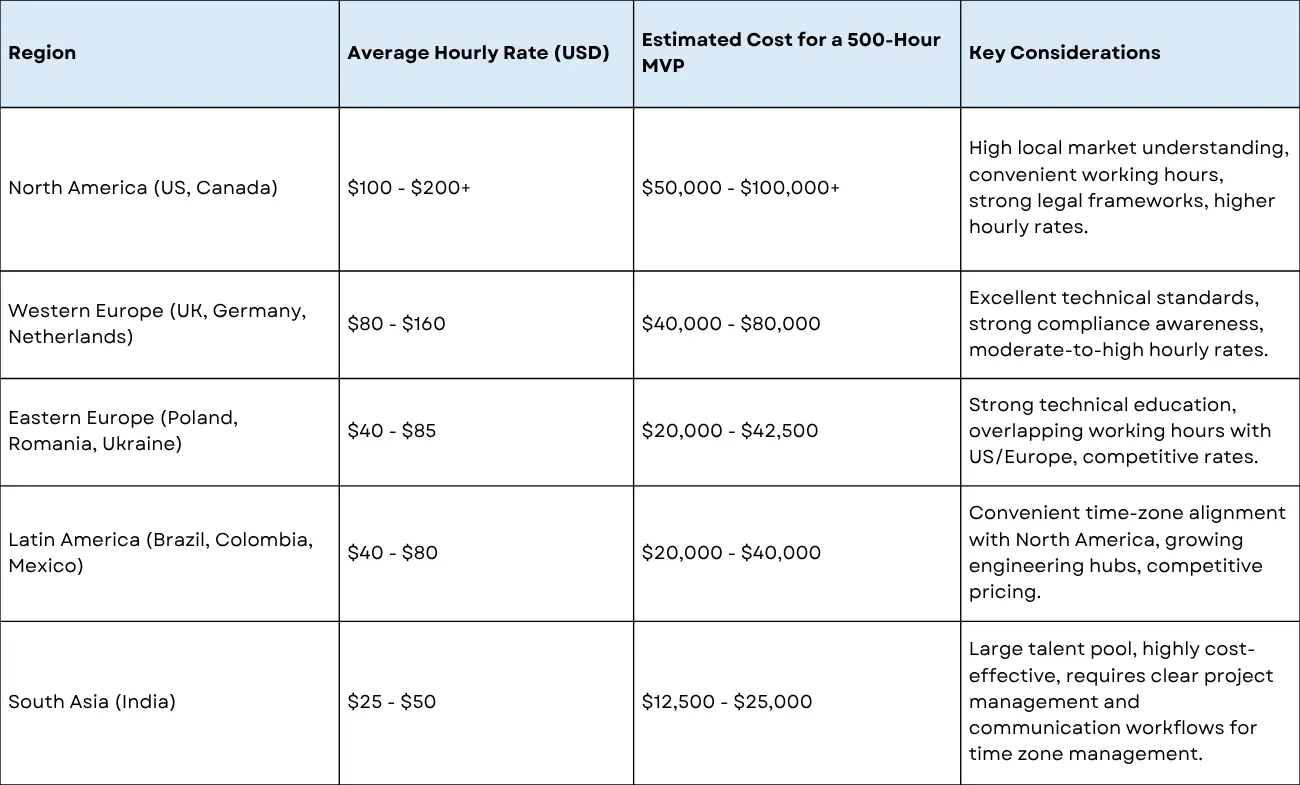
When selecting a development partner, weigh hourly rates against time-zone alignment, communication efficiency, and relevant domain experience.
MVP Development Cost by Hiring Model
How you staff your project determines your degree of control, execution speed, technical risk, and total spend.
- Freelancers: Offer lower hourly rates and flexible terms, but require strong technical oversight from you and introduce single-point-of-failure risks. Best for small MVPs or self-contained tasks.
- In-House Team: Provides complete control over priorities and deep product alignment, but represents the highest total cost due to recruitment, salaries, benefits, and operational overhead. Best for well-funded teams planning continuous iteration post-launch.
- Software Development Agency: Delivers a complete team (UI/UX designer, developers, QA engineer, project manager) with established delivery workflows and clear accountability. While rates are higher than freelancers, turnaround is structured and predictable. Best for end-to-end execution.
- Dedicated Development Team: Functions as a full-time external extension of your team with a predictable monthly burn rate. Best for teams with an internal CTO or product manager who need to scale development velocity quickly.
MVP Development Timeline
Building an MVP typically takes 2 to 5 months (8 to 20 weeks), depending on scope clarity, design iterations, and testing cycles:
- Weeks 1-2 (Discovery & Wireframing): Product roadmap definition, wireframing, user flows, and technical architecture planning.
- Weeks 3-4 (UI Design & System Setup): Design system creation, database schema design, and cloud infrastructure configuration.
- Weeks 5-8 (Core Development): Frontend building, backend business logic implementation, and core workflow integration.
- Weeks 9-10 (Integrations & Polish): API implementations, payment setup, third-party service connections, and feature freeze.
- Weeks 11-12 (Testing & Launch): Quality assurance testing, performance tuning, security verification, and deployment.
Timelines expand when project scope changes mid-sprint, third-party API credentials are delayed, or user acceptance criteria lack clarity.
What Does an MVP Budget Include?
A balanced MVP budget covers the entire product lifecycle beyond writing code:
- Discovery & Product Specification (10%): User flow mapping, feature prioritization, and technical specification writing.
- UI/UX Design (15%): Creating user journeys, wireframes, visual interface designs, and interactive prototypes.
- Frontend & Backend Engineering (55%): Client-side development, application logic, database setup, and external API connections.
- Quality Assurance & Testing (10%): Manual functional testing, automated checks, cross-device testing, and basic security scans.
- Project Management & Deployment (10%): Sprint coordination, client communications, production cloud setup, and app store submissions.
Practical Ways to Reduce MVP Costs
Controlling software development costs relies on disciplined scope management and smart architecture choices:
- Focus on One Core Problem: Avoid adding secondary features in your first release. Address the single primary pain point your product solves.
- Launch on a Single Platform First: Validate your concept on the web or a single mobile OS (iOS or Android) before expanding to additional platforms.
- Use Cross-Platform Frameworks: When mobile is essential, tools like React Native or Flutter cut costs by allowing a single codebase for both iOS and Android.
- Leverage Third-Party Services: Use established providers for standard utilities like payment processing (Stripe), authentication (Firebase/Auth0), and transactional email (SendGrid).
- Adopt Existing UI Kits: Accelerate interface creation with pre-built design libraries instead of custom coding every visual component.
- Test Wireframes First: Validate interactive prototypes with actual users before writing code. Design updates cost significantly less than refactoring software architecture.
Common Budgeting Mistakes to Avoid
- Building a Full Product Instead of an MVP: Packing long-term roadmap features into version 1.0 inflates costs and delays initial validation.
- Skipping Quality Assurance: Bypassing structured QA testing leads to buggy launches, low user retention, and expensive emergency fixes later.
- Forgetting Post-Launch Operating Costs: Infrastructure hosting, database scaling, API fees, and ongoing maintenance require operational funding after launch (typically 15% to 20% of initial build costs annually).
- Selecting Partners Solely on the Lowest Price: Exceptionally low quotes often indicate misunderstood project requirements, inexperienced staffing, or hidden add-on costs down the road.
- Adding Unvalidated Features Mid-Project: Changing feature specifications during active development disrupts sprint schedules and increases total billable hours.
Step-by-Step Cost Estimation Framework
Use this structured sequence to build a realistic estimate before approaching development partners:
- Define the Primary User Journey: Map the step-by-step path a user takes from initial signup to completing their main objective in the app.
- Categorize Features by Priority: Separate features into “Must-Have for Launch” and “Future Enhancements.” Move all non-essential items to Phase 2.
- Choose the Platform: Select web, mobile, or cross-platform based on user access preferences.
- Identify Integration Requirements: List necessary third-party tools (payment gateways, mapping services, communication APIs).
- Request Hourly Work Estimates: Ask engineering partners for task estimates in hours rather than lump-sum figures to evaluate operational scope accurately.
- Include a Contingency Buffer: Add a 15% to 20% reserve to your total budget to cover unforeseen technical edge cases or adjustments during testing.
If you have an MVP idea and want to discuss your development requirements, budget, and technology needs with our team, get in touch: https://www.rlogical.com/contact/
Realistic MVP Budgeting Example
This hypothetical scenario shows how budget components come together for a mid-complexity application:
Project Overview: B2B Service Booking Platform
- Target Platform: Responsive Web Application
- Core Features: User authentication, provider search filters, scheduling engine, Stripe payment processing, automated email alerts, basic admin panel.
- Team Model: Nearshore / Offshore Agency
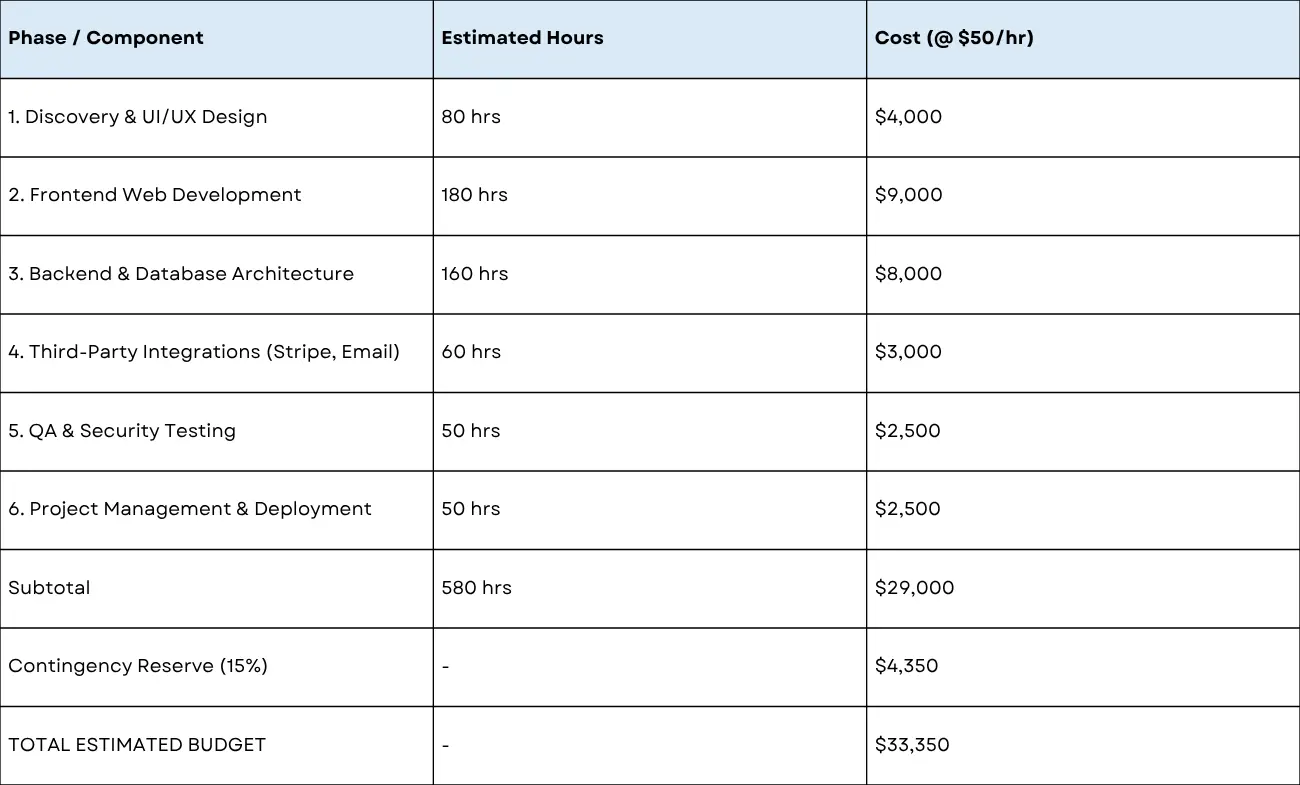
Note: This sample breakdown is for planning purposes. Actual costs vary based on exact functional specifications, performance requirements, and engineering partner rates.
Frequently Asked Questions
1. What is the average MVP development cost in 2026?
Most custom MVPs built by professional teams range from $25,000 to $65,000. Simple web utilities can cost under $20,000, while specialized healthcare, fintech, or AI applications often exceed $80,000.
2. How long does it take to develop an MVP?
Most builds take 8 to 16 weeks. Simple projects with minimal integrations can land in 4 to 6 weeks, while applications with complex backend logic or strict compliance rules can extend beyond 20 weeks.
3. Is it cheaper to hire freelancers for an MVP?
Freelancers usually offer lower hourly rates, but managing multiple independent contractors requires significant technical coordination. Lack of central QA or project management can lead to rework that raises overall spend.
4. How does AI impact MVP development costs?
AI tools accelerate repetitive coding tasks and help catch early bugs, boosting engineering speed. However, system architecture, custom logic, user experience design, and security checks still depend on experienced human developers.
5. What post-launch costs should I plan for?
Set aside 15% to 20% of your initial build budget per year to cover server hosting, database scaling, API subscription fees, security updates, and maintenance.
Final Takeaway
Estimating your MVP development cost is about aligning software scope with key business objectives rather than chasing a fixed market price.
By prioritizing a single, core user problem, you keep initial technical complexity low, choose an efficient software stack, and reach market quickly. The primary goal of an MVP is obtaining real user feedback to guide your product’s evolution efficiently.