Share



Published on 19 October, 2026
| Last Updated on 16 October, 2026
Traditional enterprise IT environments often reach a point where aging physical hardware, prolonged hardware procurement cycles, and rigid capacity limits constrain business growth. Software delivery slows down because internal engineering teams spend weeks waiting for server provisioning rather than focusing on product capabilities. Maintaining on-premises data centers requires substantial capital expenditure and continuous manual maintenance for hypervisors, cooling systems, and physical security.
Moving workloads away from traditional data centers is a complex architectural transition. It is not an administrative task or an automated lift-and-shift exercise; it is an overhaul of how an organization builds, secures, scales, and operates software systems.
Cloud migration is the structured transfer of digital business operations including applications, databases, data stores, networking topologies, identity management systems, and third-party integrations from on-premises infrastructure, private data centers, or legacy hosting environments to public or hybrid cloud providers such as Amazon Web Services (AWS), Microsoft Azure, or Oracle Cloud Infrastructure (OCI).
Migration spans several distinct operational vectors:
For enterprises exploring cloud adoption and infrastructure solutions, Rlogical provides cloud services to support different business and technical requirements. https://www.rlogical.com/cloud-service-company/
Organizations frequently treat cloud migration and cloud modernization as interchangeable terms, but they represent separate engineering initiatives:
Organizations planning cloud migration can also evaluate platform-specific consulting and implementation services based on their existing infrastructure and long-term business goals.https://www.rlogical.com/azure-consulting-services/
Enterprises evaluate cloud adoption to address specific operational friction points. The decision is driven by technical and business requirements rather than abstract industry trends.
For instance, a retail platform experiencing massive seasonal traffic spikes has a different scalability problem than an internal enterprise resource planning system with predictable, flat workloads. The former benefits substantially from elastic resource scaling, whereas the latter may see little financial benefit from autoscaling and requires careful total cost of ownership evaluation before moving.
A common misconception is that cloud infrastructure is inherently cheaper than maintaining physical hardware. Cloud economics are governed by utility pricing models. While cloud removes upfront capital expenditure and replaces it with operating expenditure, poor governance can quickly inflate monthly bills.
The financial benefit of the cloud relies on workload optimization, continuous rightsizing, autoscaling configuration, and FinOps practices. Organizations that lift-and-shift poorly optimized monolithic applications without adjusting resource allocations often experience higher ongoing operational costs in the cloud than they did on-premises.
Scalability describes an architecture’s ability to handle growing workloads by adding resources. Elasticity is the ability to automatically scale resources up and down dynamically based on real-time demand. While cloud platforms provide the underlying compute and storage primitives, applications must be architected correctly to take advantage of these features.
Cloud infrastructure reduces infrastructure lead times. Developers can spin up staging environments, testing clusters, and production pipelines using infrastructure-as-code tools. This eliminates administrative bottlenecks and accelerates software release cycles.
Enterprise resilience depends on robust backup, replication, and failover mechanisms. Cloud providers offer geographically distributed regions and availability zones that allow organizations to replicate data and state across distinct physical fault domains. This minimizes recovery point objectives and recovery time objectives during unexpected infrastructure outages.
Building reliable systems on-premises requires dedicated engineering overhead for database clustering, patch management, load balancing, and monitoring. Cloud providers offer managed services for relational and non-relational databases, message brokers, stream processing, identity providers, and observability tooling, reducing operational maintenance burdens.Businesses considering AWS-based infrastructure can explore cloud services that align with their application deployment, scalability, and operational requirements.https://www.rlogical.com/aws-cloud-services/
Deploying applications closer to global user bases is simplified through content delivery networks, globally distributed databases, and multi-region deployments. This architecture minimizes network latency and improves user experience worldwide.Enterprises evaluating Google Cloud for distributed workloads and cloud infrastructure can review available services to assess their platform requirements. https://www.rlogical.com/google-cloud-services/
When infrastructure can be defined via code and managed through APIs, developer workflows become streamlined. Continuous integration pipelines can provision ephemeral preview environments for pull requests, run automated testing suites, and deploy updates with minimal manual intervention.
Cloud adoption does not automatically make an enterprise secure. Security in the cloud operates under a shared responsibility model (as defined in foundational cloud architecture frameworks from AWS, Microsoft Azure, and NIST SP 800-145): the cloud provider secures the underlying infrastructure, while the enterprise is responsible for securing what runs on it including data encryption, identity and access management, network security groups, operating system patching, and application code configuration. Major cloud platforms provide extensive security, auditing, key-management, and compliance capabilities, but their effectiveness depends entirely on architecture and configuration.
By moving away from static server allocations, enterprises can utilize pay-as-you-go pricing, reserved instances, committed use discounts, and automated storage tiering. Savings are realized when engineering teams actively monitor resource utilization, eliminate idle assets, and optimize database queries and storage lifecycles.
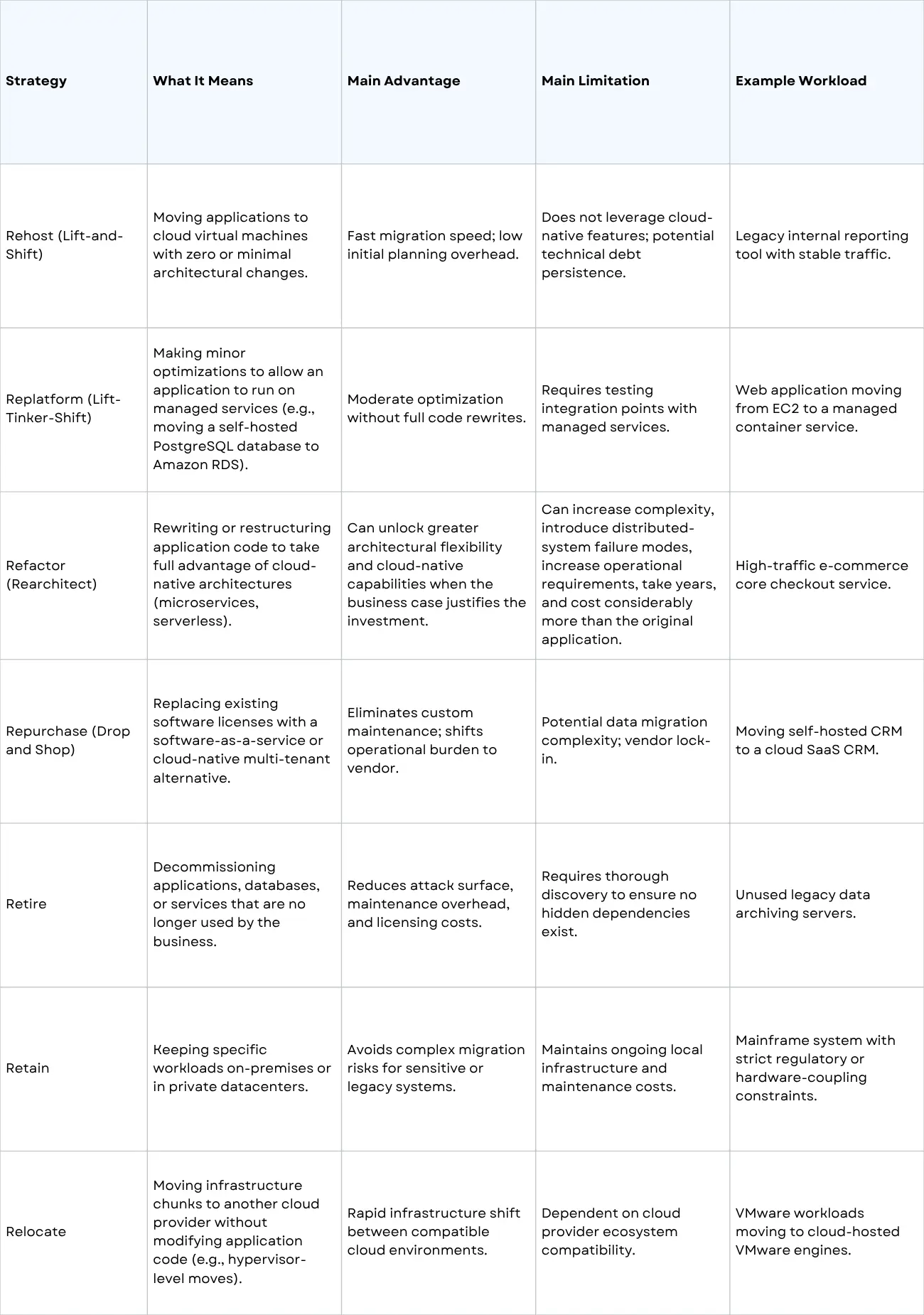
Enterprise architecture teams categorize migration approaches using the 7 Rs framework (originally established by Gartner and adapted across major cloud providers like AWS). Selecting the correct strategy for each workload depends on technical debt, business value, and available engineering resources.
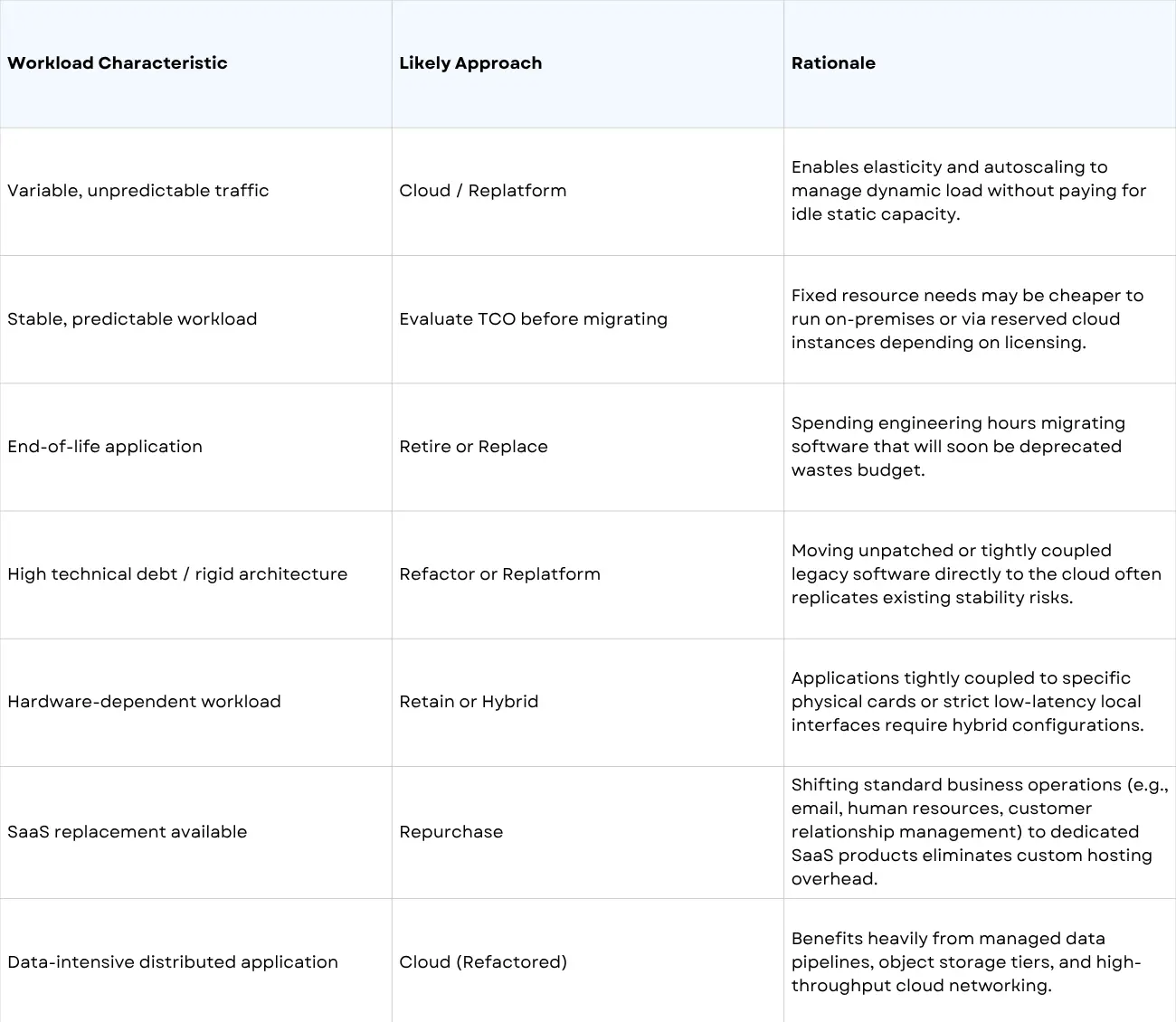
Migrating an enterprise portfolio requires an empirical evaluation framework rather than an ideology-driven move-everything-to-the-cloud mandate. Workloads should be evaluated individually based on technical characteristics, business criticality, and financial impact:
To understand the operational shift of cloud migration, consider how a standard application architecture evolves from a traditional on-premises setup to a modern enterprise cloud deployment.
[Users] ➔ [Hardware Load Balancer] ➔ [Monolithic Application Server] ➔ [Self-Hosted Relational Database]
[Users] ➔ [CDN / WAF] ➔ [Cloud Load Balancer] ➔ [Containerized Application Services (Auto-scaled)] ➔ [Managed Distributed Database]
│
├── [Message Queue] ➔ [Background Workers] ➔ [Object Storage]
│
└── [Centralized: IAM + Logging + Monitoring + Secrets + CI/CD]
Enterprise migration requires a structured, multi-wave approach coordinated across business units, security teams, and engineering groups.
[Wave 0: Discovery & Portfolio Rationalization] ➔ [Wave 1: Low-Risk Applications] ➔ [Wave 2: Supporting Platforms] ➔ [Wave 3: Business-Critical Workloads] ➔ [Wave 4: Complex & Legacy Workloads] ➔ [Wave 5: Optimization & Decommissioning]
A successful migration is not measured by how many servers an enterprise moves. Organizations should track concrete performance indicators before, during, and after migration:
Enterprise cloud migration costs cannot be expressed as a single flat figure. Total expenditure is a function of:
Organizations should calculate cost by evaluating total cost of ownership across three vectors: migration execution costs (labor, tooling, data transfer), parallel running costs (operating both old and new environments during transition), and steady-state post-migration operational expenses.
Cloud migration is recommended when an organization faces physical hardware refresh cycles, needs elastic scalability for fluctuating user demand, requires global presence without building data centers, or wants to accelerate software delivery using managed services. Conversely, migration should be deferred or handled via hybrid approaches if applications have extreme, predictable baseline loads that make on-premises hardware cheaper, or if unresolvable legacy dependencies prevent cloud execution.
Cloud migration is the process of moving digital assets, including data, databases, networking configurations, and applications, from on-premises infrastructure or legacy data centers to a cloud computing environment.
The 7 Rs are Rehost, Replatform, Refactor, Repurchase, Retire, Retain, and Relocate. They represent the primary strategic options available to enterprises when evaluating how to handle individual workloads during a migration initiative.
Migration timelines vary widely based on portfolio size, application complexity, architecture state, and team size. Simple rehosting projects for small portfolios can take weeks, while complex enterprise refactoring initiatives can span multiple quarters or years.
Cloud migration involves initial investments in planning, engineering labor, and parallel running costs. While cloud infrastructure can reduce ongoing operational overhead, improper governance and unoptimized workloads can result in higher long-term costs.
Cloud security is governed by the shared responsibility model. Cloud providers secure underlying physical and virtual infrastructure, while enterprises must configure identity management, encryption, network controls, and application security. Properly configured cloud environments offer advanced security tooling.
Cloud migration focuses on relocating workloads to cloud infrastructure, whereas cloud modernization involves rewriting or restructuring applications to utilize native cloud features like microservices and serverless architecture.
A successful migration is not measured by how many servers an enterprise moves. It is measured by whether the resulting environment is easier to operate, secure, scale, and change.
Jatin Panchal is an innovation-driven entrepreneur, and the Founder & Managing Director of Rlogical Techsoft Pvt. Ltd. He believes modern leadership is driven by innovation, adaptability, and the transformative power of Artificial Intelligence. He focuses on helping businesses accelerate digital growth through AI-powered solutions, intelligent automation, Cloud, blockchain, IoT, and scalable enterprise technologies. With a strong strategic vision and future-focused mindset, he is passionate about building technology ecosystems that improve efficiency, drive innovation, and create long-term business value for global clients.
Global insights on technology trends, best practices, and digital transformation strategies.
A proven track record of high-impact deliveries across industries and technologies
Share with us. We'll assess its feasibility, suggest the right tech stack, and share a clear cost & timeline.
Years of Experience
Projects
Countries
Engineers
Verified Client Reviews
Industry Served