Share



Published on 15 October, 2026
| Last Updated on 15 October, 2026
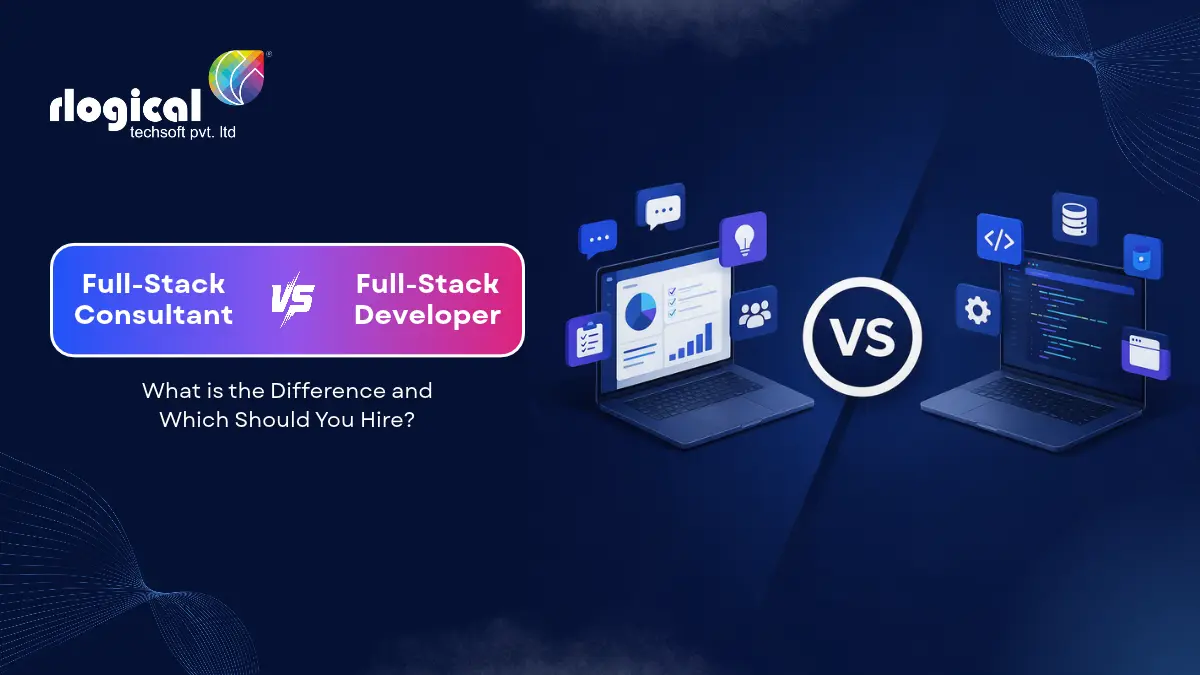
When planning a software initiative, technology decision-makers often conflate full-stack developers with full-stack consultants. Treating them as interchangeable roles leads to misaligned expectations, bloated engineering budgets, or stalled projects.
The distinction is not simply that a developer writes code while a consultant talks about it. Both roles possess broad technical competency across the frontend, backend, and databases. The fundamental divergence lies in accountability, scope of responsibility, and primary objective: developers often focus on implementing and evolving an existing technical direction, though senior engineers routinely challenge architecture and make structural choices, whereas consultants are typically brought in when architectural direction, technical assessment, risk analysis, or broader strategic decisions require specialized expertise.
A common misconception is that consultants and developers operate in entirely different technical domains. In practice, both professionals may work with the exact same technology stack: React, Node.js, Python, PostgreSQL, AWS, Docker, and RESTful APIs.
The division does not lie in what technologies they know, but in how they apply that knowledge, what decisions they own, and what problem your organization is hiring them to solve. A developer might use Node.js to build a specific set of microservices within a pre-determined framework, while a consultant might use that same Node.js experience to evaluate whether a multi-tenant architecture can handle a tenfold surge in concurrent traffic without breaking.
Full-stack expertise is also valuable when building AI-powered applications that combine user interfaces, backend services, data processing, and intelligent features. These technologies work together to create scalable AI-driven software solutions. https://www.rlogical.com/blog/full-stack-ai-development
A full-stack developer is an implementation-focused engineer capable of building user interfaces, wiring business logic, designing database schemas, and writing APIs. Their work is typically evaluated by the quality, reliability, maintainability, and timely delivery of the software they build according to specified project requirements.
Core responsibilities typically include:
Crucially, full-stack does not imply equal mastery of every layer. A developer might excel in backend distributed systems while handling frontend tasks proficiently, or vice versa. Their core value centers on execution capacity and feature delivery.
A full-stack consultant brings end-to-end technical proficiency, but applies it through an advisory, architectural, and diagnostic lens. Their primary objective is to align technical architecture with business goals, mitigate risk, and solve complex structural problems.
Core responsibilities typically include:
While consultants spend significant time on strategy, design, and oversight, many are fully capable of writing code. When they write code, it is usually to build proof-of-concepts, resolve high-risk technical blocks, or establish foundation patterns for an internal team to follow.
| Area | Full-Stack Developer | Full-Stack Consultant |
| Primary focus | Feature execution, implementation, and code delivery | Technical strategy, architecture, and problem-solving |
| Typical responsibility | Building, testing, and maintaining software features | Diagnosing risks, designing systems, and guiding teams |
| Technical decision-making | Tactical (how to build a specific component or feature) | Strategic (what technologies, patterns, and structures to use) |
| Architecture | Often implements and evolves existing architecture; senior developers also make major architectural choices | Typically brought in to define, review, or refactor system architecture |
| Coding | Full-time, day-to-day production coding | Selective; focuses on prototypes, core patterns, or critical fixes |
| Requirements discovery | Translates product requirements into technical tasks | Analyzes business goals to define technical scope and constraints |
| Team collaboration | Works peer-to-peer with product, QA, and other developers | Advises leadership, mentors engineers, and bridges business and tech |
| Project scope | Specific features, sprints, or ongoing product maintenance | Discovery phases, audits, architectural overhauls, or strategic advisory |
| Engagement model | Staff augmentation, dedicated team member, or long-term contract | Advisory, milestone-based audits, or short-to-medium-term strategic leadership |
| Long-term ownership | High code ownership and routine maintenance responsibilities | Low ongoing code ownership; hands over architecture to internal teams |
| Best suited for | Expanding product features, executing backlogs, and scaling engineering output | Resolving scaling issues, technology selection, and architecture design |
Job titles in software engineering are fluid. A senior full-stack developer at one company may carry more architectural authority and technical sophistication than someone bearing the title of consultant at another. Conversely, a consultant could be a mediocre developer with strong communication skills who struggles to build production-grade systems.
When evaluating talent, look past the title and assess:
Hire a full-stack developer when your immediate constraint is execution capacity and your technical path is clear. Common scenarios include:
Once your project requirements and technical direction are clear, the next step is finding the right engineering talent. Businesses looking to expand their development capabilities can explore suitable hiring options to find developers with the skills and experience needed for their projects. https://www.rlogical.com/hire-full-stack-developer/
Hire a full-stack consultant when your immediate constraint is direction, clarity, or structural risk, and moving directly into implementation could create unnecessary technical debt or lock the team into an unsuitable architecture. Common scenarios include:
Ask these diagnostic questions to identify your primary requirement:
Senior and principal-level full-stack developers often take on consulting responsibilities as they gain experience. Conversely, skilled consultants often retain sharp coding skills.
Combining resources is common and effective in mature engineering operations. For example, organizations frequently bring in a consultant for a short discovery and architecture phase to establish patterns and review risks, followed by hiring full-stack developers to execute the resulting technical blueprint alongside internal teams.
The financial investment for each role depends on distinct cost drivers rather than a fixed market rate:
A mid-stage SaaS company experiences slow queries, increasing AWS costs, duplicated business logic across an aging Node/Python service, and an internal team that isn’t sure whether to rewrite or refactor.
Evaluating candidates requires more than checking their technical skills. Businesses should also consider practical experience, problem-solving ability, communication, and project requirements to select the right professionals for their teams. https://www.rlogical.com/blog/how-to-hire-full-stack-developers/
Neither role is universally better; they solve entirely different engineering problems.
If you are unsure whether your project needs implementation capacity, architectural guidance, or both, start by defining the technical problem you need to solve. From there, you can determine whether a developer, consultant, or hybrid team is the appropriate fit. You can also explore Rlogical’s full-stack development services -https://www.rlogical.com/full-stack-development/ to understand the development support available for your project.
For small, well-defined projects with a clear scope and established stack, a consultant is usually unnecessary; a full-stack developer or small engineering team is sufficient. A consultant becomes valuable when a small project carries high architectural risk, unproven technical assumptions, or complex integration requirements.
A senior full-stack developer with strong system design experience can often perform light consulting tasks like evaluating architecture or choosing libraries. However, if the project requires independent organizational auditing, high-level legacy modernization strategy, or neutral stakeholder mediation, a dedicated consultant is more effective.
Ask them to describe a past project where an architecture failed or faced severe scaling bottlenecks, how they diagnosed the root cause, and what trade-offs they considered when designing the solution. Avoid candidates who offer a single silver-bullet technology for every problem.
Look for solid fundamentals across your chosen stack, familiarity with automated testing and version control, strong debugging skills, and the ability to communicate technical blockers clearly to team leads.
If a consultant is involved in the initial discovery phase, they should lead technology selection based on long-term scalability and team constraints. If development is starting on an established product, senior developers should help guide stack decisions within existing project boundaries.
Hire a consultant before development starts when the product concept involves novel technical challenges, tight security or compliance requirements, multi-service architectures, or high uncertainty regarding which technologies to adopt.
Rahul Panchal is a visionary technology entrepreneur and the Founder & Managing Director of Rlogical Techsoft Pvt. Ltd. Passionate about the power of Artificial Intelligence, he focuses on helping businesses transform through AI-driven solutions, intelligent automation, and data-centric digital ecosystems. Alongside AI, his expertise spans scalable web and mobile platforms, Cloud, IoT, and modern enterprise technologies enabling organizations to innovate faster, optimize operations, and build future-ready digital products with real business impact.
Global insights on technology trends, best practices, and digital transformation strategies.
A proven track record of high-impact deliveries across industries and technologies
Share with us. We'll assess its feasibility, suggest the right tech stack, and share a clear cost & timeline.
Years of Experience
Projects
Countries
Engineers
Verified Client Reviews
Industry Served