Share



Published on 12 October, 2026
| Last Updated on 12 October, 2026
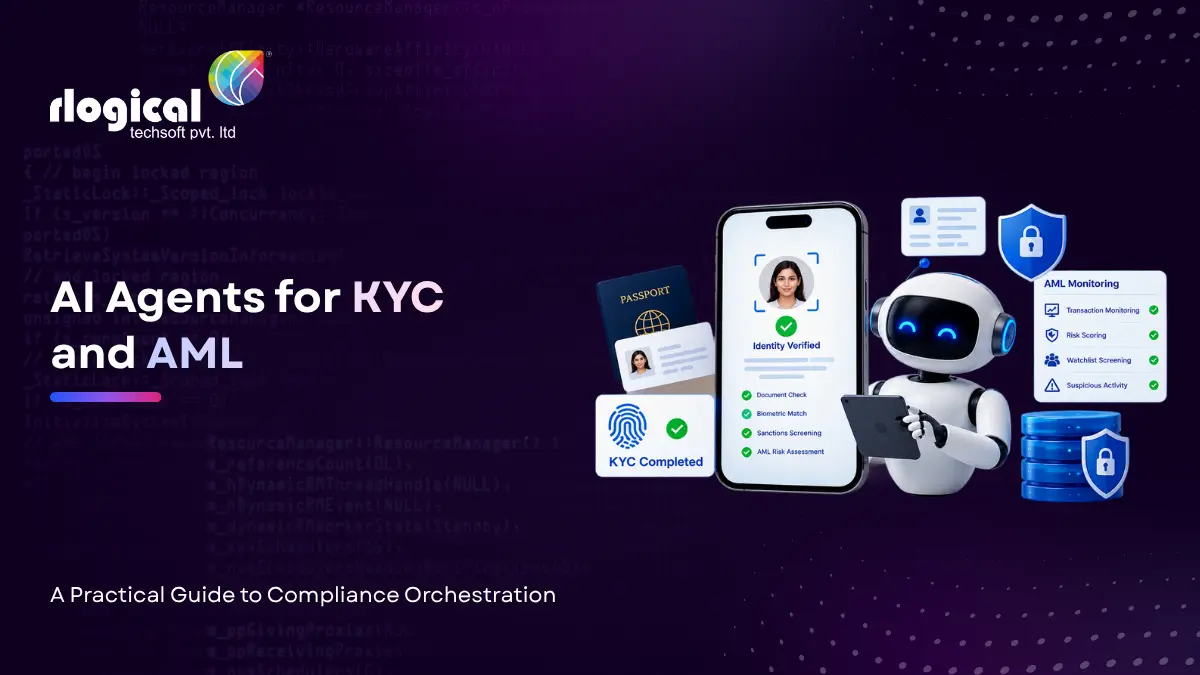
KYC and AML teams often spend more time collecting and reconciling information than analyzing risk.
A single investigation may involve customer profiles, transaction history, sanctions and PEP screening, corporate records, ownership information, adverse media, and previous cases. Traditional automation can handle individual tasks, but coordinating information across these systems remains difficult.
AI agents can act as an orchestration layer around existing KYC and AML infrastructure. They can retrieve approved data, analyze documents, enrich alerts, identify missing evidence, and prepare investigation summaries for human review.
The objective is not to replace compliance professionals. It is to reduce repetitive investigation work while maintaining appropriate controls, auditability, and human oversight.
The objective is not to replace compliance professionals. It is to reduce repetitive investigation work while maintaining appropriate controls, auditability, and human oversight.
For a broader look at how AI agents can be designed to automate and coordinate business workflows, see the related article here: https://www.rlogical.com/blog/ai-agent-development-for-businesses/
AI agents are software systems that can coordinate multiple tasks to achieve a defined objective. In this context, KYC covers customer identification and verification, while AML covers controls used to detect and prevent financial crime. CDD and EDD refer to standard and enhanced levels of customer due diligence.
In KYC and AML operations, an agent can connect approved data sources, retrieve relevant information, analyze structured and unstructured data, and prepare outputs for a compliance workflow.
Typical capabilities include:
The important distinction is that an AI agent can coordinate several steps rather than simply execute one predefined rule.
An AI agent should generally operate within defined permissions rather than function as an unrestricted compliance decision-maker.
A typical workflow is:
Data collection → Verification → Screening → Risk analysis → Case enrichment → Alert prioritization → Human review → Decision → Audit trail → Ongoing monitoring
The agent can automate information gathering and case preparation while the institution retains appropriate approval, escalation, and accountability controls.
AI agents do not replace every existing compliance technology. Each technology solves a different part of the workflow.
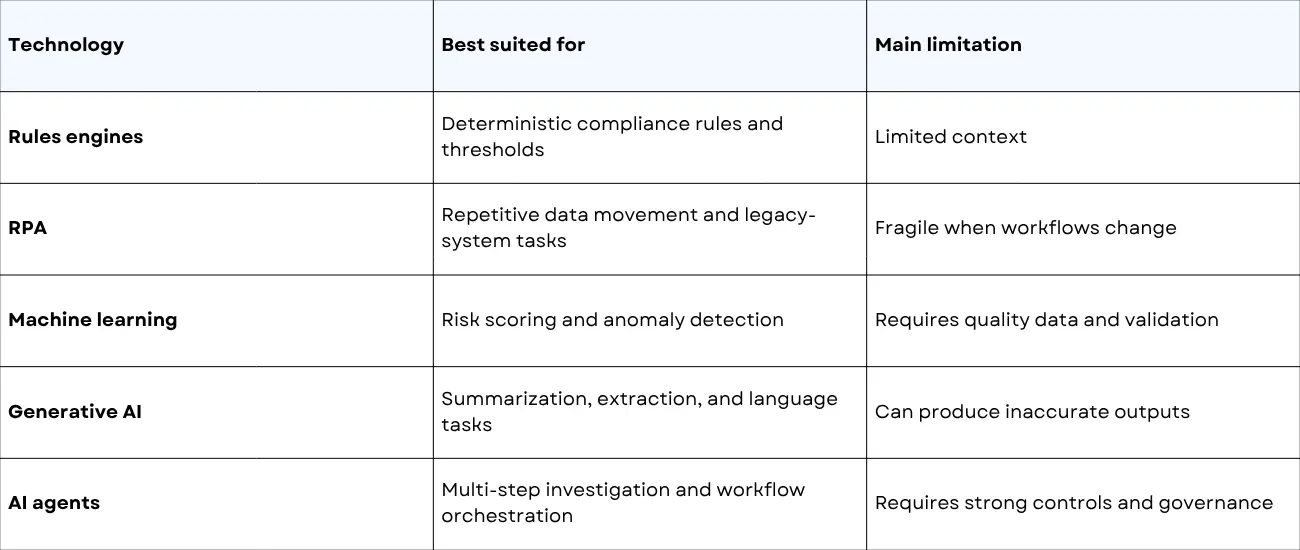
The practical approach is usually to combine these technologies rather than replace one with another.
Agents can assist with document classification, information extraction, identifying missing or inconsistent details, and coordinating verification workflows against approved data sources.
Agents can help investigate potential matches by combining names with available contextual information such as location, date of birth, company relationships, and other approved data.
Agents can gather risk indicators from multiple systems and prepare a structured summary for the compliance team.
Complex businesses may require investigators to examine corporate structures, multiple jurisdictions, ownership records, directors, and related individuals.
AI agents can assist by:
The resulting analysis should remain traceable to source records and subject to appropriate human review.
Agents can support event-driven reviews when relevant changes occur, such as ownership changes, sanctions updates, management changes, or significant changes in customer activity.
AI agents do not necessarily replace transaction-monitoring engines. A practical architecture separates detection from investigation:
Transaction Monitoring Engine → Alert → AI Agent → Context Enrichment → Case Summary → Human Investigation
The monitoring engine can continue using rules or machine-learning models to detect unusual activity. The AI agent can then retrieve customer information, transaction history, counterparty details, and other approved sources to enrich the alert.
This approach allows existing detection controls to remain in place while reducing the manual work involved in investigation.
A typical AI-assisted investigation can follow this workflow:
The exact division of responsibilities should follow the institution’s policies, regulatory obligations, and risk controls.
When appropriately designed and governed, AI agents can help compliance teams:
Actual results depend on data quality, integrations, workflow design, model performance, and human oversight.
AI agents cannot eliminate false positives by themselves. They can, however, help analysts investigate alerts with additional context.
For example, an agent can retrieve:
It can then organize this evidence and prepare a disposition summary for analyst review.
This may reduce the manual effort involved in investigating alerts, while detection thresholds and final decisions remain subject to existing controls and governance.
A practical architecture can be organized into five layers:
The agent layer should operate within defined permissions and should not bypass existing compliance controls.
Building this type of solution may require AI/ML model development, system integration, and workflow automation tailored to compliance requirements. Learn more about Rlogical’s AI/ML development services: https://www.rlogical.com/ai-ml-development-services/
AI agents introduce several risks that require controls before production deployment:
These risks should be addressed through access controls, source verification, testing, monitoring, human review, and audit logging.
Human oversight should depend on the risk and consequence of the action, rather than an arbitrary AI confidence score.
Human review may be required for:
Lower-risk administrative tasks may be automated when they have been appropriately tested and controlled.
The key question is not simply how confident the AI is, but what happens if its output is wrong.
AI agents used in financial compliance need governance that covers both the underlying models and the actions the agent can take.
Key controls include:
A practical implementation can follow five phases:
Start with a narrow workflow and expand only after performance and controls have been validated.
There is no standard price for an AI-agent compliance system. Cost depends on the workflow, integrations, data providers, transaction volume, security requirements, model usage, and governance needs.
Major cost drivers include:
A focused proof of concept is typically much simpler than a production system integrated with multiple banking and compliance platforms.
If your team needs technical support to design and implement these AI-powered workflows, you can explore options for hiring AI/ML developers here: https://www.rlogical.com/hire-ai-ml-developer/
Start with tasks that are repetitive, information-heavy, and relatively easy for analysts to review.
Good starting points include:
Higher-impact decisions, including complex risk assessments, sanctions dispositions, SAR/STR decisions, and customer offboarding, require stronger controls and appropriate human involvement.
Compliance automation is moving toward more connected, event-driven workflows.
Areas to watch include:
Financial institutions will also need to consider how criminals use AI for synthetic identities, document manipulation, scams, and other forms of financial crime.
AI agents are software systems that coordinate multiple compliance tasks, such as retrieving information, analyzing documents, enriching alerts, and preparing investigation summaries within defined controls.
Traditional automation generally follows predefined rules or workflows. AI agents can coordinate multiple tools and handle more varied structured and unstructured information.
They can support transaction-monitoring workflows by enriching alerts with customer, transaction, counterparty, and other relevant information. They do not necessarily replace the underlying monitoring engine.
They can help analysts investigate alerts with more context and organize supporting evidence. Whether this reduces false-positive workload depends on system design, data quality, and governance.
AI agents can automate parts of research and case preparation, but high-impact compliance decisions require appropriate human oversight and accountability.
Start with a narrow, repetitive workflow such as document processing, evidence gathering, or alert enrichment. Test it using representative cases before expanding to higher-risk workflows.
AI agents can support KYC and AML operations by coordinating information gathering, contextual analysis, alert enrichment, and case preparation.
They work best as an orchestration layer alongside existing rules, models, compliance systems, and human expertise.
Successful implementation depends on clearly defined agent permissions, reliable data sources, human escalation points, auditability, security controls, and continuous monitoring.
For financial institutions, the practical question is which compliance workflows can benefit from AI while maintaining the controls required for responsible financial crime compliance.
Rlogical helps fintechs and financial institutions build AI-powered compliance workflows, including agent orchestration, RAG, enterprise integrations, human-in-the-loop systems, data protection, and audit infrastructure.
If you are evaluating an AI-agent use case for KYC or AML, Rlogical can help assess the workflow, architecture, integrations, and implementation requirements.
Jatin Panchal is an innovation-driven entrepreneur, and the Founder & Managing Director of Rlogical Techsoft Pvt. Ltd. He believes modern leadership is driven by innovation, adaptability, and the transformative power of Artificial Intelligence. He focuses on helping businesses accelerate digital growth through AI-powered solutions, intelligent automation, Cloud, blockchain, IoT, and scalable enterprise technologies. With a strong strategic vision and future-focused mindset, he is passionate about building technology ecosystems that improve efficiency, drive innovation, and create long-term business value for global clients.
Global insights on technology trends, best practices, and digital transformation strategies.
A proven track record of high-impact deliveries across industries and technologies
Share with us. We'll assess its feasibility, suggest the right tech stack, and share a clear cost & timeline.
Years of Experience
Projects
Countries
Engineers
Verified Client Reviews
Industry Served