

Share




Published on 13 February, 2016
| Last Updated on 29 April, 2026
If you’re planning to launch an iOS app this year, the first question on your mind is probably about budget. Honestly, there’s no single number we can give you, because two apps that look almost identical on the surface can end up costing very different amounts. But here’s a useful range to anchor your thinking: a quality iOS app built with an experienced team in India typically costs anywhere from $5,000 to $170,000 in 2026, depending on what you’re trying to build.
This guide breaks down the real numbers, the latest tech stack you should care about, and what to expect when you hire an iOS app development company in India. We’ve put together this post based on the questions our team gets asked almost every week, from founders, product managers, and enterprise clients alike.
If you’d rather skip ahead and talk to someone, you can always explore our iOS app development services directly.
| App Type | Cost in USD | Timeline |
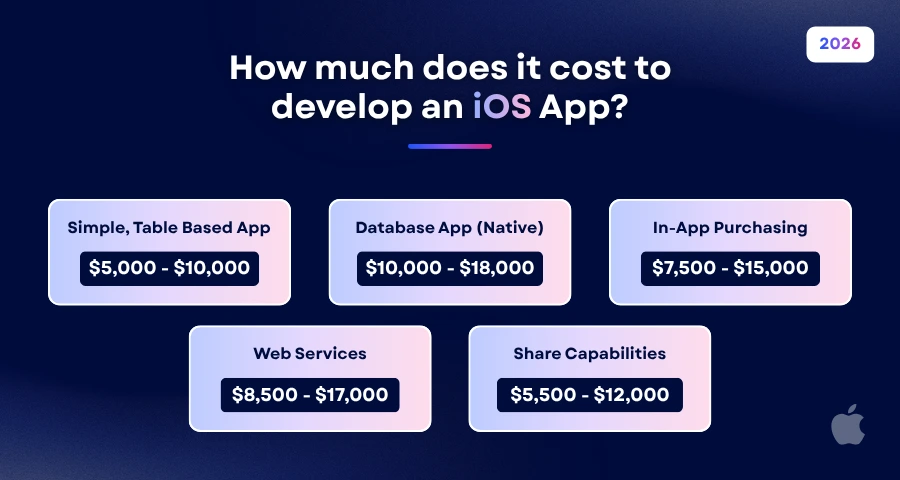
| Simple Table Based App | $5,000 to $10,000 | 4 to 8 weeks |
| Database App (Native) | $10,000 to $18,000 | 8 to 14 weeks |
| In App Purchasing App | $7,500 to $15,000 | 6 to 12 weeks |
| Web Service Integrated App | $8,500 to $17,000 | 8 to 14 weeks |
| Sharing & Social Capabilities | $5,500 to $12,000 | 4 to 10 weeks |
| Medium Complexity App | $18,000 to $36,000 | 4 to 6 months |
| Enterprise Grade App | $36,000 to $170,000 | 6 to 12 months |
A decade ago, iOS apps were simpler. A basic table view app could be coded over a weekend, and most apps were targeting one or two iPhone screen sizes. Things have shifted a lot since then.
Today, that same category of app needs to handle multiple iPhone sizes, iPadOS, the latest iOS 26 SDK, Apple Intelligence integration on supported devices, and the new Liquid Glass design materials Apple introduced last year. Add in privacy compliance and the App Store review bar, and what once took a few weeks now takes a couple of months, even for something that looks “simple” from the outside.
The increase in cost reflects the increase in capability. Modern iOS apps can do things that just weren’t possible ten years ago. On device AI, spatial computing for Apple Vision Pro, real time collaboration, and deep integrations with the rest of Apple’s ecosystem are now table stakes.
Hourly rates are one of the biggest reasons businesses around the world choose India for iOS development. At Rlogical, our standard rates fall between $15 and $25 per hour, which sits right in the sweet spot for quality and affordability.
Here’s a broader picture of what you’ll see across the Indian market in 2026:
| Developer Level | Hourly Rate (USD) |
| Junior iOS Developer | $12 to $22 |
| Mid Level iOS Developer | $18 to $30 |
| Senior iOS Developer | $30 to $50 |
| AI/ML Specialist for iOS | $35 to $60 |
| Development Agency (full team) | $20 to $50 |
For comparison, iOS developers in the United States typically charge $100 to $150 per hour, and Western Europe averages $70 to $120 per hour. That’s why so many companies outsource iOS development to India. You can save 50 to 70 percent without compromising on quality, provided you pick the right partner.
Budget: $5,000 to $10,000
These are content driven apps with list views, basic navigation, and either static or lightly dynamic data. Think directory apps, recipe apps, basic news readers, and informational apps.
What’s included: SwiftUI based interface, 5 to 10 screens, basic onboarding, App Store deployment.
Budget: $10,000 to $18,000
Apps that store and manage user data locally or on the cloud. Login systems, user profiles, search, and full CRUD functionality fall into this bucket.
What’s included: Native Swift code, Core Data or CloudKit integration, user authentication, push notifications.
Budget: $7,500 to $15,000
Apps with subscription models, one time purchases, or consumable items. With Apple’s StoreKit 2 framework, this category has gotten a lot more sophisticated, but also more reliable.
What’s included: StoreKit 2 integration, receipt validation, subscription management, server side purchase verification.
Budget: $8,500 to $17,000
Apps that talk to REST APIs, GraphQL endpoints, or third party services. Most modern apps fall into this category, since it’s hard to think of a useful app that doesn’t connect to something.
What’s included: API integration, real time data sync, error handling, offline caching.
Budget: $5,500 to $12,000
Apps with content sharing, social media integration, deep linking, and Share Extensions.
What’s included: ShareLink API, Universal Links, social platform SDKs, App Clips support.
This is where the conversation has really changed. Most of what’s listed below didn’t exist (or wasn’t relevant) when we first wrote this guide. If you’re budgeting for a new app today, these are the things to factor in.
Apple Intelligence is now available on iPhone 15 Pro, iPhone 15 Pro Max, the iPhone 16 series, and supported iPad and Mac models. It’s a game changer for businesses that want to add AI features without sending user data to a server. Core ML and the Foundation Models framework let you run inference right on the device, with strong privacy protections built in.
Additional cost: $1,800 to $7,200, depending on what you’re trying to do.
Common use cases include intelligent chatbots, content recommendations, image recognition, predictive text, and natural language search.
If you want your iOS app to also work on Apple Vision Pro through visionOS, expect additional development effort. RealityKit, ARKit, and Reality Composer Pro are the core tools for building spatial experiences, and they have their own learning curve.
Additional cost: $3,600 to $18,000 for adapting an existing iOS app to visionOS, or building a spatial first experience.
iOS 26 introduced Liquid Glass, Apple’s adaptive material system that combines refraction, reflection, and dynamic animations. The good news? Apps built on SwiftUI inherit these materials automatically when you use standard components. Custom UI components, though, may need to be redesigned to match the new aesthetic.
Cost impact: Usually included in design budget, but legacy UIKit apps may need $2,400 to $9,500 for refactoring.
Privacy is a core requirement now, not an afterthought. Apple requires App Tracking Transparency prompts, privacy nutrition labels, and clear data handling disclosures. On top of that, GDPR, India’s DPDP Act, and CCPA all affect how you architect data flows.
Additional cost: $600 to $3,000 for privacy framework integration and legal documentation.
Subscription apps are a major share of App Store revenue today. Building a robust subscription system involves StoreKit 2, server side validation, paywall design, win back campaigns, and analytics. That’s quite a bit more than just adding an “upgrade” button.
Additional cost: $2,400 to $6,000 for a complete subscription infrastructure.
App Clips let users access a small portion of your app without downloading the full thing. They work well for food ordering, ride hailing, ticketing, and quick payments through Apple Pay.
Additional cost: $1,200 to $4,800.
These are the line items that tend to surprise first-time app owners. None of them are huge on their own, but they add up:
A few practical things that have worked well for our clients over the years:
A few reasons that explain why India has been a top destination for iOS work for over a decade now:
Q: What is the minimum cost to build an iOS app in 2026?
A: A simple iOS app starts at around $5,000 for a basic MVP with 5 to 10 screens, when you build it with an experienced offshore team in India.
Q: How long does it take to build an iOS app?
A: A simple app takes 4 to 8 weeks. A medium complexity app takes 4 to 6 months. Enterprise apps can take 6 to 12 months or longer, especially if compliance or large scale infrastructure is involved.
Q: Is native iOS development better than Flutter or React Native?
A: Native Swift gives you the best performance and access to all Apple frameworks. Cross platform tools save cost when you need both iOS and Android. The right choice depends on your priorities, whether that’s performance, cost, time to market, or feature parity.
Q: Do I need to pay Apple every year?
A: Yes. Apple charges $99 per year for the standard Developer Program. You’ll need this to publish on the App Store. The Apple Developer Enterprise Program is $299 per year.
Q: What’s included in iOS app maintenance?
A: Bug fixes, OS compatibility updates, third party SDK updates, security patches, and minor feature additions. Plan for 15 to 25 percent of the original development cost per year. It’s not optional if you want your app to stay healthy.
Q: Can I get an iOS app built for under $4,000?
A: It’s tough to deliver a quality iOS app for less than $5,000. Anything cheaper usually means template based work, lower quality, or hidden compromises that come back to bite you later.
The cost of building an iOS app in 2026 depends on what you want to build, who you build it with, and how you scope the project. India remains a highly cost effective destination for quality iOS app development, with rates 50 to 70 percent lower than Western markets and a deep talent pool that understands modern Apple frameworks like SwiftUI, Core ML, ARKit, and visionOS.
Whether you’re a startup launching your first app or an enterprise modernizing existing software, the right development partner will help you balance cost, quality, and time to market. Start with a clear scope, prioritize an MVP approach, and build for the long term.
Ready to build your iOS app? Get in touch for a free consultation and project quote today.
Jatin Panchal is an innovation-driven entrepreneur, and the Founder & Managing Director of Rlogical Techsoft Pvt. Ltd. He believes modern leadership is driven by innovation, adaptability, and the transformative power of Artificial Intelligence. He focuses on helping businesses accelerate digital growth through AI-powered solutions, intelligent automation, Cloud, blockchain, IoT, and scalable enterprise technologies. With a strong strategic vision and future-focused mindset, he is passionate about building technology ecosystems that improve efficiency, drive innovation, and create long-term business value for global clients.
Global insights on technology trends, best practices, and digital transformation strategies.
A proven track record of high-impact deliveries across industries and technologies
Share with us. We'll assess its feasibility, suggest the right tech stack, and share a clear cost & timeline.
Years of Experience
Projects
Countries
Engineers
Verified Client Reviews
Industry Served