Share



Published on 06 April, 2026
| Last Updated on 13 July, 2026
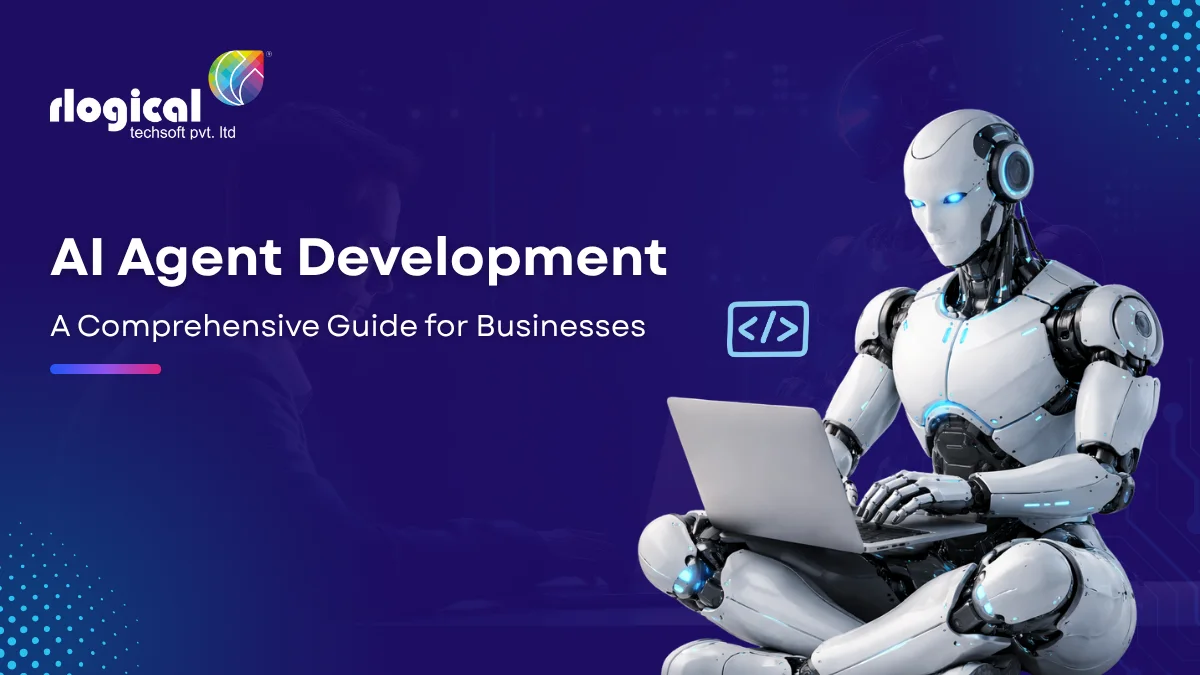
The landscape of enterprise automation is undergoing a massive shift. For years, businesses relied on traditional software or rule based systems to handle repetitive tasks. These tools followed rigid if-then logic, meaning they broke down the moment they encountered an unexpected variable.
Today, the emergence of autonomous AI agents is completely redefining how companies operate. Instead of executing pre-written scripts, modern enterprises use intelligent agents capable of independent thought, critical reasoning, and real time execution. This transition from passive tools to active digital workers is transforming corporate productivity.
To understand how these technologies fit into a broader corporate strategy, businesses can explore comprehensive AI/ML development services to map out their digital transformation.
AI agent development is the specialized process of designing, training, and deploying autonomous software entities that can achieve specific goals without step by step human intervention. Unlike standard software applications that require constant user prompts, an intelligent agent evaluates its environment, processes contextual data, and takes independent action to achieve a desired outcome.
At its core, an intelligent agent behaves as a goal oriented system. You do not tell the agent how to do a task; you give it the final objective and the parameters it must work within. For example, instead of just pulling raw data into a spreadsheet, an advanced agent can analyze financial market fluctuations, compile an industry report, and automatically email relevant stakeholders with strategic recommendations. These capabilities rely on a sophisticated combination of machine learning models, natural language processing, and deep system integrations.
In a commercial context, AI agent development translates to creating specialized digital employees. These agents are engineered to take over multi step workflows that previously required hours of manual labor from human staff.
By functioning independently within corporate networks, AI agents can manage supply chains, optimize logistics, handle complex compliance checks, and coordinate B2B communications. They act as background engines of productivity, minimizing human intervention to the bare minimum of final approval and high level oversight.
To understand why AI agents are so powerful, it helps to look at their operational loop. They do not just react blindly. They follow a continuous cycle of perception, reasoning, and execution.
An AI agent constantly ingests multi modal data from its environment. This input might include direct user text prompts, live voice feeds, sensor data, or structured database updates. Through natural language processing, the agent extracts the core intent, identifies key entities, and recognizes the underlying business context.
Once the data is understood, the agent moves into the reasoning phase. It looks at the ultimate goal it was assigned and breaks that goal down into a sequence of smaller tasks. Advanced agents use large language models to weigh different strategies, predict potential outcomes, and select the most efficient path forward based on historical patterns and business rules.
After deciding on a path, the agent executes the required actions. Crucially, AI agents are not locked inside an isolated sandbox. They can interact with external environments by writing code, utilizing APIs, updating customer relationship management platforms, modifying databases, and sending automated messages across internal communication channels.
Every action taken provides a data point for future optimization. Through continuous reinforcement learning and feedback loops, the agent analyzes its mistakes, tracks performance metrics, and refines its decision-making parameters over time. This makes the system more accurate the longer it remains active in your business ecosystem.
Many business leaders use the terms “chatbot” and “AI agent” interchangeably, but they represent two entirely different levels of technology. The fundamental difference lies in their operational autonomy and capability to execute workflows.
| Feature | Standard AI Chatbot | Autonomous AI Agent |
|---|---|---|
| Primary Focus | Linear conversation and text interaction. | Goal achievement and active task execution. |
| Operation Model | Reactive (responds only when prompted). | Proactive (takes independent initiative). |
| System Interaction | Limited to retrieving and displaying data. | Deeply integrated via APIs to modify systems. |
| Problem Solving | Follows pre defined conversation trees. | Creates custom step by step action plans dynamically. |
To illustrate this with an example, consider an ecommerce order tracking issue. A traditional chatbot can look up an order number and state that a package is delayed. A true AI agent can see the package is delayed, identify a replacement item in the nearest warehouse, update the inventory database, issue a shipping label, and send a personalized apology email to the customer with the new tracking number.
To explore how conversational tech can be upscaled into broader systems, reading about AI chatbots for business automation provides excellent foundational context.
Investing in custom agent development offers measurable competitive advantages across multiple operational layers.
Autonomous agents are versatile tools that can be customized for almost any industry vertical.
While old bots frustrate users with generic scripts, AI agents can access account histories, process refunds, troubleshoot technical issues, and re-route accounts based on complex customer lifetime value metrics.
Agents can monitor incoming digital leads, research a prospect’s company background, score the lead quality, send out hyper customized outreach emails, and book a meeting directly onto a sales representative’s calendar.
In internal corporate environments, agents can handle routine administrative friction. They can scan employee expense receipts, verify them against company policy, flag irregularities, and push approved items straight to the payroll system.
An autonomous agent can manage live marketplace operations by dynamically altering product prices based on competitor tracking, predicting inventory shortages, and automatically placing re-orders with suppliers.
In financial departments, agents can cross reference bank statements with internal accounting ledgers, run automated fraud detection models, and generate predictive cash flow forecasts for executive teams.
Building a reliable, production grade AI agent requires a synchronized stack of advanced software layers.
Building a successful enterprise agent requires a methodical engineering approach. Haphazard deployment often leads to security risks and erratic software behavior.
Before writing code, define what success looks like. Identify the specific metric you want to improve, whether that is reducing customer wait times by fifty percent or cutting data processing costs.
Isolate the specific workflow the agent will own. Document every data source, system dependency, and potential edge case the agent will encounter during its daily routines.
Choose an underlying LLM framework and orchestration engine that aligns with your security compliance needs. Determine if you require an open source model hosted locally or a closed source commercial API.
Design how the agent will think and access tools. Create the memory storage architecture so the agent can remember past interactions, and set the strict system boundaries it is not allowed to cross.
Build the system and fine tune the model using your proprietary corporate data. Connect the agent to your internal networks through secure API endpoints so it can communicate with existing enterprise tools.
Conduct exhaustive testing in a sandbox environment. Force the system to handle corrupted data, strange user inputs, and system disconnects to ensure it remains stable, safe, and accurate before going live.
For companies looking to leverage top tier engineering talent for this process, reviewing the landscape of an experienced AI development company in India can help streamline development lifecycles.
To ensure long term project viability and high return on investment, engineering teams should follow these core principles.
Deploying autonomous agents comes with distinct hurdles that technical leadership must actively manage.
Integrating modern generative AI with old legacy IT architecture can be incredibly complex. Teams must build custom wrapper APIs and data translation layers to bridge the technical gap smoothly.
Using customer data to power agent workflows requires rigid adherence to local privacy laws like GDPR or CCPA. Businesses must ensure their agent models do not leak sensitive information or use public data pools for training.
Large language models are occasionally prone to hallucinations or incorrect inferences. Developers must build multi layered verification checks, programmatic validators, and hard coded fallback protocols to catch errors before they manifest in real world actions.
We are rapidly moving toward a corporate ecosystem powered by networked digital assistants. In the coming years, individual specialized agents will not just work in isolation; they will talk to each other. A sales agent will seamlessly pass data to a logistics agent, which will immediately coordinate with a finance agent to balance corporate sheets in real time.
Companies that master agent development now will establish an insurmountable operational advantage. They will move faster, make fewer errors, and free up their human workforce to focus entirely on high level creative strategy and business growth.
To bring these capabilities into your business structure, you can hire an AI ML developer who specializes in custom autonomous workflows and enterprise integrations.
AI agent development is a fundamental shift in how businesses interact with technology. By moving past simple, rigid automation and embracing flexible, goal oriented digital workers, modern companies can achieve unprecedented levels of productivity and operational agility.
If you are looking to lower your overhead costs, eliminate administrative friction, and dramatically improve your customer interactions, investing in custom autonomous agents is the most definitive path forward. The future of competitive business is autonomous, and the time to build your digital workforce is now.
A standard chatbot is reactive and restricted to text conversations based on pre-defined scripts. An AI agent is autonomous, goal-oriented, and can execute multi-step workflows—such as updating databases, issuing shipping labels, or managing inventory—by interacting with external systems via APIs without human intervention.
Yes. While integrating with older, legacy IT architecture can be complex, developers can build custom wrapper APIs and data translation layers. This allows modern AI agents to securely read and write data across older systems alongside modern platforms like Salesforce or SAP.
AI agents use continuous reinforcement learning and feedback loops. Every time an agent processes an input or executes a task, it logs the performance data and outcomes. This allows it to adapt to historical patterns, correct behavioral errors, and optimize its future decision-making parameters.
The primary security challenges include data privacy violations and unauthorized access to sensitive files. To mitigate these risks, businesses must implement strict role-based access controls, ensure all data is heavily encrypted both in transit and at rest, and adhere rigidly to local privacy regulations like GDPR or CCPA.
No. Instead of replacing humans, AI agents are designed to take over repetitive, manual, and administrative friction. This frees up human staff to focus on high-level creative strategy, complex problem-solving, and critical business growth initiatives while maintaining final oversight of the agent’s work.
Rahul Panchal is a visionary technology entrepreneur and the Founder & Managing Director of Rlogical Techsoft Pvt. Ltd. Passionate about the power of Artificial Intelligence, he focuses on helping businesses transform through AI-driven solutions, intelligent automation, and data-centric digital ecosystems. Alongside AI, his expertise spans scalable web and mobile platforms, Cloud, IoT, and modern enterprise technologies enabling organizations to innovate faster, optimize operations, and build future-ready digital products with real business impact.
Global insights on technology trends, best practices, and digital transformation strategies.
A proven track record of high-impact deliveries across industries and technologies
Share with us. We'll assess its feasibility, suggest the right tech stack, and share a clear cost & timeline.
Years of Experience
Projects
Countries
Engineers
Verified Client Reviews
Industry Served