

Share



Published on 11 March, 2026
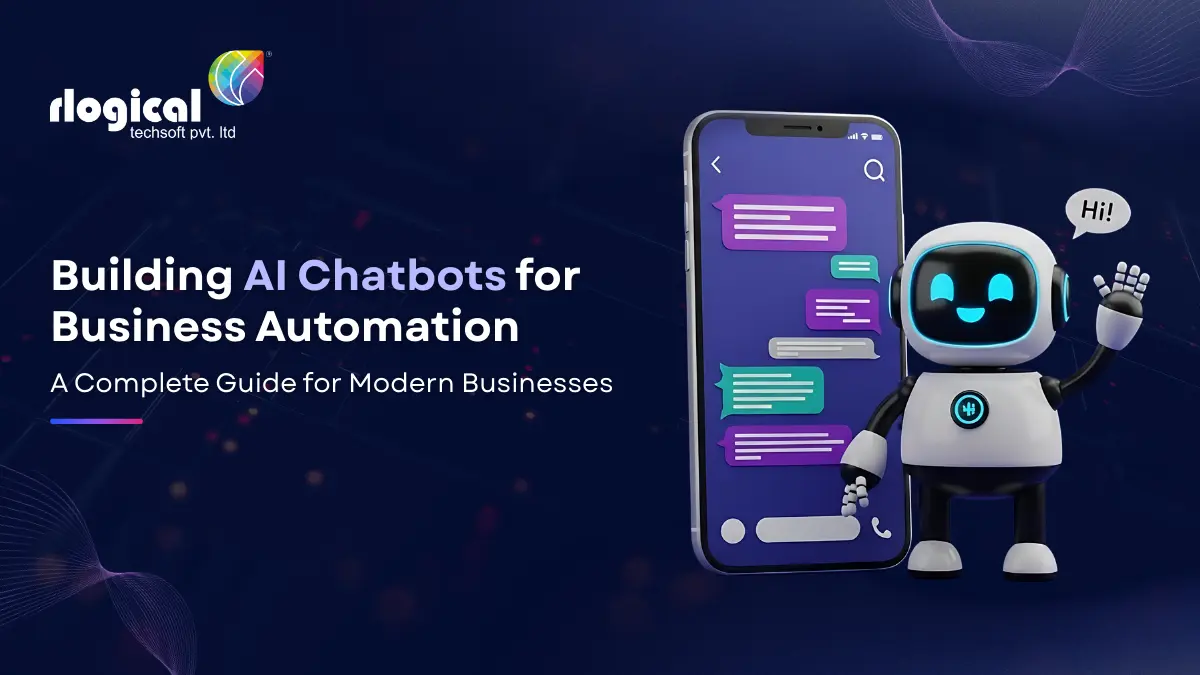
Businesses today are constantly searching for ways to improve efficiency, reduce operational costs, and deliver better customer experiences. One of the most powerful technologies helping organizations achieve these goals is the AI chatbot.
These intelligent systems are transforming how companies interact with customers, manage workflows, and automate routine tasks.
Organizations planning to implement AI chatbot solutions for automation can also connect with experienced professionals at https://www.rlogical.com/contact/ to discuss their business requirements and explore suitable AI solutions.
An AI chatbot is a software application designed to simulate human conversation using artificial intelligence technologies. Unlike traditional chat systems that rely on predefined rules, AI chatbots use machine learning and natural language processing to understand user intent and generate intelligent responses.
These systems analyze user messages, interpret context, and provide relevant answers in real time. AI chatbots can be integrated into websites, mobile applications, messaging platforms, and even internal enterprise tools.
Businesses use AI chatbots to automate interactions with customers, streamline workflows, and improve productivity. With the right implementation, chatbots can handle thousands of conversations simultaneously while maintaining high levels of accuracy and consistency.
The adoption of AI chatbots has increased rapidly across industries. Companies recognize that intelligent automation can significantly improve both customer experience and operational efficiency.
AI chatbots can handle customer queries around the clock. Unlike human agents who work limited hours, chatbots provide continuous support, ensuring customers always receive assistance when they need it.
Customers expect quick responses when interacting with businesses online. AI chatbots respond instantly, reducing waiting times and improving satisfaction.
Customer support teams often require large numbers of agents to handle inquiries. AI chatbots automate many routine tasks, allowing companies to reduce staffing costs while maintaining service quality.
Employees can focus on complex or strategic tasks while chatbots manage repetitive activities such as answering common questions, processing requests, or collecting customer information.
As businesses grow, customer interactions increase. AI chatbots scale easily and can manage large volumes of conversations without affecting performance.
AI chatbots are versatile tools that can automate a wide range of business processes. Below are some of the most common and impactful applications.
Customer service is one of the most popular uses for AI chatbots. These systems can answer frequently asked questions, assist users with troubleshooting, provide product details, and guide customers through purchasing processes.
By automating routine customer inquiries, businesses reduce support workloads and provide faster assistance.
AI chatbots can interact with website visitors, ask relevant questions, and collect valuable information about potential customers. This helps businesses identify qualified leads and pass them to sales teams for further engagement.
Automated lead qualification improves efficiency and ensures sales representatives focus on high value prospects.
Many industries rely on appointment based services, including healthcare, consulting, and beauty services. AI chatbots can manage scheduling tasks, check availability, and book appointments without human intervention.
This automation reduces administrative work and improves scheduling accuracy.
Online retailers use AI chatbots to guide customers through product discovery, answer questions about items, provide personalized recommendations, and assist with order tracking.
These features enhance the shopping experience and help increase conversion rates.
AI chatbots are not limited to customer facing applications. Many companies use chatbots internally to assist employees with tasks such as HR inquiries, IT support, document access, and workflow management.
Internal automation improves productivity and reduces the burden on support teams.
Building an effective AI chatbot requires a combination of technologies that enable intelligent communication and automation.
Natural language processing allows chatbots to understand human language. This technology analyzes text inputs, identifies user intent, and extracts relevant information from conversations.
With advanced NLP capabilities, chatbots can handle complex questions and respond naturally.
Machine learning enables chatbots to improve over time. By analyzing past conversations and user interactions, the chatbot learns how to provide better responses and handle new situations.
Modern AI chatbots often rely on large language models that can generate human like responses. These models enable more natural conversations and allow chatbots to handle diverse topics.
Businesses looking to implement advanced AI powered chatbot solutions can explore professional AI and machine learning development services at https://www.rlogical.com/ai-ml-development-services/ to build scalable and intelligent automation systems.
For effective automation, chatbots must connect with existing business systems such as CRM platforms, databases, ecommerce systems, and customer support tools. These integrations allow chatbots to access data and perform tasks automatically.
Developing a successful AI chatbot requires a clear strategy and structured development process.
The first step is identifying the specific objectives of the chatbot. Businesses should determine whether the chatbot will focus on customer support, sales assistance, internal operations, or a combination of tasks.
Clear goals ensure the chatbot delivers measurable value.
Understanding the target audience helps developers design conversations that match user expectations. Businesses should consider factors such as user behavior, common questions, and preferred communication channels.
Conversation design plays a critical role in chatbot success. Developers must map out possible user interactions and create logical response paths that guide users toward their goals.
Well designed conversations improve usability and reduce frustration.
Select the Right Technology Stack
Choosing the appropriate technology stack is essential for building scalable chatbots. This includes selecting AI platforms, backend frameworks, and integration tools.
Modern development stacks often include cloud based AI services and scalable infrastructure. Businesses planning to build advanced chatbot solutions may also need experienced AI engineers to develop and deploy intelligent systems. Companies can learn more about hiring skilled professionals for AI projects at https://www.rlogical.com/hire-ai-ml-developer/.
Training the chatbot involves feeding it relevant data such as frequently asked questions, support documents, and conversation examples. This training helps the chatbot understand common queries and provide accurate responses.
Before deployment, the chatbot must be thoroughly tested to ensure it handles different scenarios correctly. Continuous optimization based on user feedback helps improve performance over time.
Building a chatbot is not just about technology. Businesses must also focus on usability, security, and long term scalability.
Chatbot responses should be concise and easy to understand. Complex or confusing responses can frustrate users and reduce effectiveness.
Even the best AI chatbots cannot handle every situation. Businesses should provide users with the option to connect with a human agent when necessary.
Chatbots often process sensitive user information. Proper encryption, secure data storage, and compliance with privacy regulations are essential.
AI chatbots should evolve based on real user interactions. Monitoring conversations and analyzing feedback helps identify areas for improvement.
The chatbot interface should be intuitive and responsive across devices. A well designed interface encourages users to engage with the chatbot.
Despite their benefits, AI chatbots also present certain challenges that businesses must address.
Human language is often ambiguous. Chatbots may struggle with complex questions or unclear inputs. Continuous training helps improve accuracy.
Integrating chatbots with multiple business systems can be technically challenging. Proper planning and experienced developers are essential.
Some users may expect chatbots to provide human level understanding. Businesses must clearly communicate chatbot capabilities while ensuring high quality responses.
The future of AI chatbots is closely linked to advancements in artificial intelligence and machine learning. As these technologies continue to evolve, chatbots will become even more intelligent and capable.
Future chatbots will likely handle complex workflows, provide deeper personalization, and integrate seamlessly across digital ecosystems. Voice based interactions, predictive assistance, and proactive customer engagement are also expected to become more common.
For businesses, AI chatbots will play an increasingly important role in improving operational efficiency and delivering superior digital experiences.
AI chatbots are transforming the way businesses operate and interact with customers. By automating repetitive tasks, providing instant support, and improving operational efficiency, chatbots help organizations achieve significant productivity gains.
Building a successful AI chatbot requires a clear strategy, the right technologies, and a strong focus on user experience. Businesses that invest in intelligent chatbot solutions can streamline operations, enhance customer engagement, and stay competitive in the digital marketplace.
As artificial intelligence continues to advance, AI chatbots will become an essential tool for business automation, enabling organizations to operate smarter, faster, and more efficiently.
Rahul Panchal is a visionary technology entrepreneur and the Founder & Managing Director of Rlogical Techsoft Pvt. Ltd. Passionate about the power of Artificial Intelligence, he focuses on helping businesses transform through AI-driven solutions, intelligent automation, and data-centric digital ecosystems. Alongside AI, his expertise spans scalable web and mobile platforms, Cloud, IoT, and modern enterprise technologies enabling organizations to innovate faster, optimize operations, and build future-ready digital products with real business impact.
Global insights on technology trends, best practices, and digital transformation strategies.
A proven track record of high-impact deliveries across industries and technologies
Share with us. We'll assess its feasibility, suggest the right tech stack, and share a clear cost & timeline.
Years of Experience
Projects
Countries
Engineers
Verified Client Reviews
Industry Served