

Share



Published on 05 March, 2026
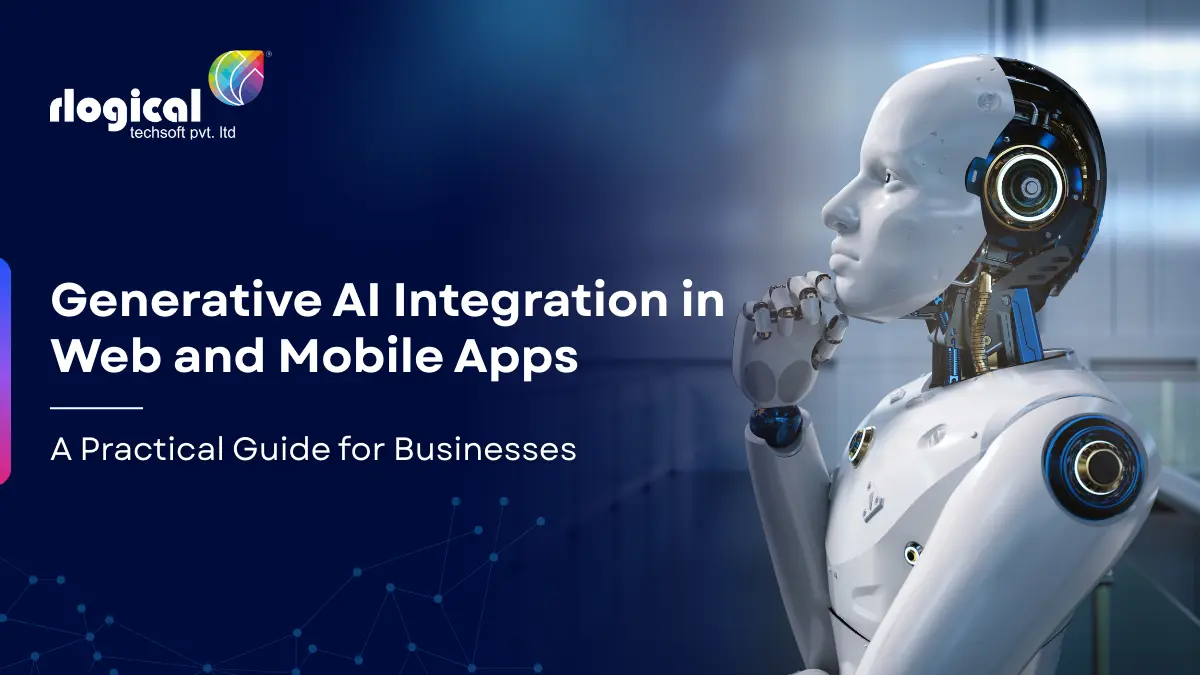
Artificial intelligence has rapidly transformed the way modern applications are built and used. Among the most influential innovations is Generative AI, a technology capable of creating human like text, images, code, and even complex insights. Businesses across industries are now integrating generative AI into web and mobile applications to enhance user experiences, automate workflows, and unlock new revenue opportunities.
From intelligent chat assistants to AI powered content generation tools, generative AI is redefining how digital platforms operate. Companies that adopt this technology early can provide smarter services, improve productivity, and stay ahead in an increasingly competitive digital landscape.
This guide explores what generative AI integration means, how it works in web and mobile apps, its key benefits, common use cases, and best practices for successful implementation.
Generative AI refers to machine learning models designed to generate new content rather than simply analyze existing data. These systems are trained on massive datasets and can produce outputs such as text, images, audio, or code that closely resemble human created content.
Modern generative AI systems rely on advanced architectures like large language models and diffusion models. These models can understand context, respond to user inputs, and produce meaningful results in real time.
However, it is also important to understand how generative AI differs from agentic AI, as both are shaping the future of intelligent applications: https://www.rlogical.com/blog/difference-between-agentic-ai-and-generative-ai
Organizations are increasingly turning to generative AI because it significantly enhances application capabilities and improves efficiency.
Generative AI allows applications to interact with users in more natural and intelligent ways. AI powered chat interfaces, personalized recommendations, and dynamic content creation provide users with highly engaging experiences.
Many business operations involve repetitive tasks such as responding to customer inquiries, drafting reports, or generating product descriptions. Generative AI can automate these processes, saving time and reducing operational costs.
AI models can analyze user behavior and preferences to generate personalized responses, recommendations, and content. This level of customization improves user satisfaction and retention.
Developers can integrate AI capabilities into applications without building complex models from scratch. With modern APIs and AI platforms, businesses can launch innovative features much faster.
Companies that adopt AI driven features often stand out in crowded markets. Intelligent automation and smarter user interactions can significantly improve brand perception and customer loyalty.
Generative AI can be integrated into a wide variety of applications across industries. Below are some of the most impactful use cases.
One of the most common applications of generative AI is intelligent conversational assistants. These chatbots can understand user queries, provide contextual responses, and assist customers in real time.
Businesses use AI chatbots for customer support, appointment booking, product recommendations, and troubleshooting. Unlike traditional rule based bots, generative AI chatbots can handle complex conversations and adapt to different scenarios.
Content creation is another major use case. AI models can generate blog posts, marketing copy, social media captions, and product descriptions based on simple prompts.
This capability is especially useful for ecommerce platforms and digital marketing tools, where large volumes of content are required regularly.
Generative AI can significantly improve search functionality within applications. Instead of showing basic keyword results, AI powered search systems understand user intent and provide relevant answers or recommendations.
Streaming platforms, ecommerce apps, and learning platforms are increasingly using AI based recommendation systems to improve user engagement.
AI assisted coding tools are becoming popular among developers. Generative AI models can suggest code snippets, detect errors, and even generate entire functions based on developer instructions.
This improves development speed and reduces the time required to build complex applications.
Applications can use generative AI to create images, graphics, and multimedia content dynamically. Design tools, marketing platforms, and gaming applications are increasingly using AI generated visuals.
For example, users can generate custom graphics, avatars, or artwork directly within an app.
Generative AI can analyze documents and generate summaries, insights, or structured data. This is particularly useful in industries such as finance, legal services, and healthcare where large volumes of documents need to be processed. To explore how generative AI is specifically revolutionizing the healthcare industry: https://www.rlogical.com/blog/generative-ai-healthcare
Integrating generative AI into web and mobile apps typically involves combining AI models with application infrastructure.
The first step is choosing the right AI model or platform. Businesses can use existing AI services through APIs or develop custom models depending on their requirements.
Popular AI platforms provide pre trained models capable of generating text, images, and other types of content.
Generative AI functionality is usually integrated into the application backend. The app sends user inputs to the AI model through an API request, and the model returns generated responses or content.
Developers then process this output and display it within the user interface.
Data plays a critical role in AI performance. Applications often combine generative models with internal databases, knowledge bases, or user data to provide more accurate responses.
This approach helps create context aware AI systems tailored to specific business needs.
The final step is designing user interfaces that allow users to interact with AI features easily. Examples include chat interfaces, AI suggestion panels, and content generation tools within the application.
A well designed interface ensures users can take full advantage of AI capabilities.
While generative AI offers powerful capabilities, successful implementation requires careful planning and execution.
Before integrating AI, businesses should identify the specific problems they want to solve. Whether the goal is improving customer support, automating content creation, or enhancing product recommendations, having clear objectives ensures the AI integration delivers measurable value.
Applications that process user data must follow strict security practices. Sensitive information should be protected through encryption, secure APIs, and proper data governance policies.
Businesses must also comply with regional data protection regulations.
AI models can be resource intensive. Developers should design efficient architectures that balance performance and cost. Techniques such as caching, prompt optimization, and model selection can help reduce expenses.
While generative AI is powerful, it is not perfect. Human review and moderation are important for ensuring the quality and accuracy of AI generated content, especially in critical applications.
AI systems should be monitored regularly to evaluate performance and user satisfaction. Feedback from users can help improve prompts, workflows, and integration strategies.

Despite its advantages, generative AI also presents certain challenges that organizations must address.
AI generated responses may sometimes contain incorrect or misleading information. Implementing validation mechanisms and reliable data sources can help mitigate this issue.
Businesses must ensure that AI systems operate responsibly and avoid generating harmful or biased content. Ethical AI practices are essential for maintaining trust.
Integrating AI into existing applications can require specialized expertise in machine learning, cloud infrastructure, and software architecture.
Partnering with experienced development teams can help organizations implement AI solutions more efficiently.
Generative AI is expected to become a core component of modern digital platforms. As AI models continue to improve, applications will become more intelligent, adaptive, and capable of performing complex tasks autonomously. To understand how this growth is already impacting specific sectors, see how generative AI is driving expansion in industrial software: https://www.rlogical.com/blog/generative-ai-industrial-software-growth
Future web and mobile apps may include advanced AI assistants, fully automated customer support systems, real time design tools, and intelligent workflow automation.
Businesses that invest in AI integration today will be well positioned to leverage these innovations and deliver superior digital experiences.
Generative AI integration is reshaping the way web and mobile applications are designed and used. By enabling intelligent automation, personalized experiences, and dynamic content creation, this technology offers tremendous opportunities for businesses across industries.
However, successful implementation requires a strategic approach that combines the right technology, secure infrastructure, and thoughtful user experience design.
Organizations that embrace generative AI early can transform their digital platforms, improve operational efficiency, and deliver innovative solutions that meet evolving user expectations.
As AI continues to advance, its integration into web and mobile applications will become not just an advantage but a necessity for businesses aiming to remain competitive in the digital era.
Jatin Panchal is an innovation-driven entrepreneur, and the Founder & Managing Director of Rlogical Techsoft Pvt. Ltd. He believes modern leadership is driven by innovation, adaptability, and the transformative power of Artificial Intelligence. He focuses on helping businesses accelerate digital growth through AI-powered solutions, intelligent automation, Cloud, blockchain, IoT, and scalable enterprise technologies. With a strong strategic vision and future-focused mindset, he is passionate about building technology ecosystems that improve efficiency, drive innovation, and create long-term business value for global clients.
Global insights on technology trends, best practices, and digital transformation strategies.
A proven track record of high-impact deliveries across industries and technologies
Share with us. We'll assess its feasibility, suggest the right tech stack, and share a clear cost & timeline.
Years of Experience
Projects
Countries
Engineers
Verified Client Reviews
Industry Served