Share



Published on 11 March, 2026
| Last Updated on 21 July, 2026
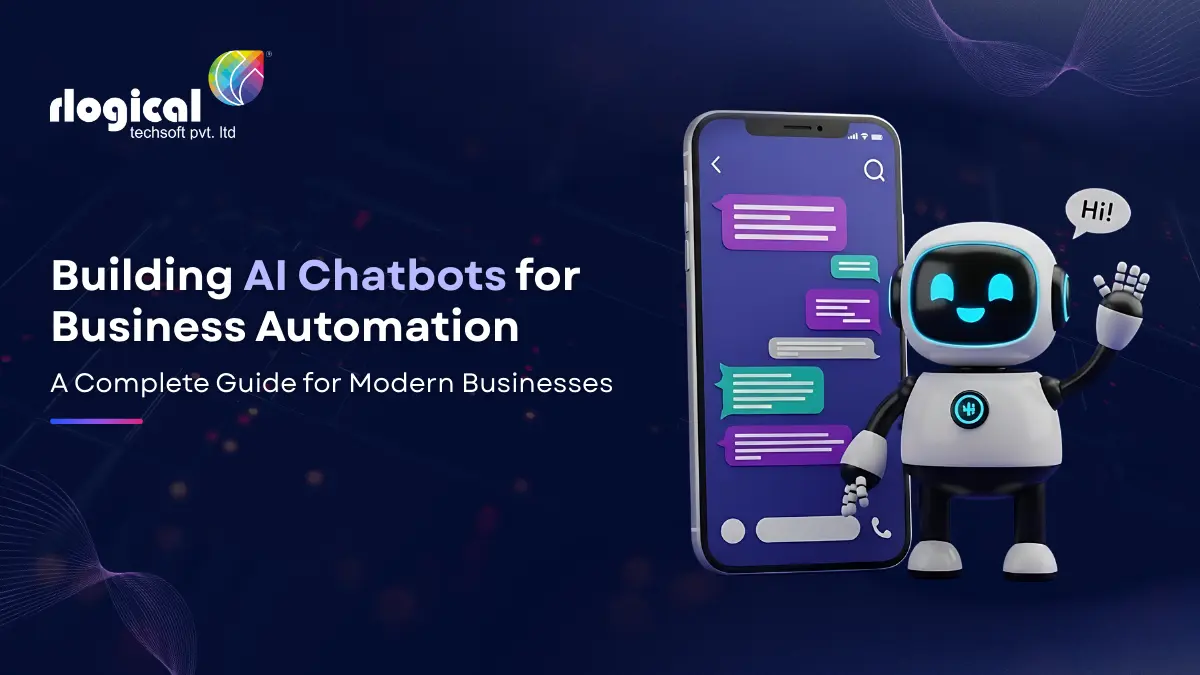
Businesses today constantly seek ways to improve efficiency, reduce operational costs, and deliver superior customer experiences. One of the most effective technologies helping organizations achieve these targets is the AI chatbot.
These intelligent systems are transforming how companies interact with customers, streamline internal workflows, and automate routine operational tasks.
Organizations planning to implement AI chatbot solutions for business automation can connect with experienced professionals at https://www.rlogical.com/contact/ to discuss specific business requirements and explore tailored AI implementations.
An AI chatbot is a software application designed to simulate natural human conversation using artificial intelligence technologies. Unlike traditional rule based chat systems that rely on static scripts, AI chatbots leverage machine learning and natural language processing to understand user intent and generate intelligent responses.
These systems analyze incoming messages, interpret context, and provide precise answers in real time. AI chatbots integrate smoothly into websites, mobile applications, messaging platforms, and internal enterprise systems.
Businesses deploy AI chatbots to automate customer communication, streamline operational workflows, and boost overall productivity. With proper implementation, chatbots manage thousands of simultaneous conversations while maintaining consistent accuracy.
The adoption of AI chatbots has accelerated across multiple industries. Companies recognize that intelligent automation significantly improves both customer satisfaction and internal operational efficiency.
AI chatbots deliver continuous support around the clock. Unlike human teams with fixed operating hours, chatbots provide immediate assistance whenever customers need help.
Modern consumers expect instant responses online. AI chatbots reply immediately, eliminating wait times and boosting customer satisfaction rates.
Scaling traditional support teams requires significant financial resources. AI chatbots automate routine customer queries, allowing companies to lower overhead costs while maintaining high service standards.
Employees can focus on high value strategic tasks while chatbots handle repetitive activities like answering routine questions, processing basic requests, or collecting visitor information.
As business traffic grows, communication demands surge. AI chatbots scale effortlessly to handle large spikes in conversation volume without diminishing performance.
AI chatbots serve as versatile tools capable of automating diverse business processes. Below are some of the most impactful applications across modern organizations.
Customer support remains the most popular application for AI chatbots. These platforms answer frequently asked questions, assist with troubleshooting, explain product details, and guide users through checkout processes. Automating routine inquiries lowers support ticket volumes and speeds up resolution times.
AI chatbots engage website visitors proactively, asking qualifying questions and collecting crucial prospect data. This automated process identifies high intent leads and passes them directly to sales representatives for immediate closing.
Service based industries like healthcare, consulting, and professional services rely heavily on appointments. AI chatbots check real time calendar availability, reserve slots, and schedule meetings automatically without manual administrative work.
Online retailers deploy AI chatbots to help shoppers discover relevant products, answer inventory questions, recommend complementary items, and share real time order tracking updates. These capabilities improve shopping experiences and boost online conversion rates.
AI chatbots also streamline internal workplace tasks. Companies use internal chatbots to assist employees with HR policy questions, IT helpdesk requests, document retrieval, and internal workflow management, reducing administrative pressure across support departments.
Building a robust AI chatbot requires combining multiple specialized technologies that enable clear communication and efficient task execution.
Natural language processing allows chatbots to interpret human language accurately. This technology parses raw text, identifies underlying user intent, and extracts key entities from conversational inputs.
Machine learning enables conversational platforms to refine their accuracy over time. By analyzing interaction logs and user feedback, chatbots learn to handle complex scenarios and deliver better responses continuously.
Modern AI chatbots frequently utilize large language models that generate fluent, contextually accurate responses. These systems make conversations feel natural across diverse operational topics.
Businesses seeking advanced AI chatbot development can explore professional technical support through https://www.rlogical.com/ai-ml-development-services/ to build scalable, enterprise grade automation systems.
To automate workflows effectively, chatbots must connect directly with existing platforms like CRMs, databases, ecommerce software, and ticketing tools. These integrations allow chatbots to retrieve customer data and execute actions automatically.
Developing a successful AI chatbot requires a structured strategic roadmap that combines technical planning with user focused design.
Identify the specific objectives your chatbot must achieve. Determine whether the platform will focus on customer service, lead capture, internal operations, or a combination of functions to ensure measurable business ROI.
Understand your audience to design conversational interactions that feel relevant and intuitive. Consider typical user behavior, frequent pain points, preferred messaging channels, and communication styles.
Construct clear conversation paths that guide users toward solutions quickly. Well structured conversation flows prevent dead ends, simplify navigation, and maintain high user satisfaction.
Choose reliable backend frameworks, AI models, and integration tools built for long term scale. Organizations seeking extra engineering capacity can explore specialized developer hiring options at https://www.rlogical.com/hire-ai-ml-developer/ to accelerate development timelines.
Train the chatbot using tailored company data, such as knowledge base articles, product catalogs, and past support tickets. High quality training data ensures accurate, context aware responses.
Test the chatbot across edge cases, complex questions, and high traffic conditions prior to launch. Gather real world usage metrics post deployment to refine response accuracy continuously.
Successful implementation requires balancing modern technology with practical usability, data security, and long term scalability.

While AI chatbots offer substantial efficiency benefits, organizations should prepare for common technical hurdles during development:
The evolution of AI chatbots remains closely tied to breakthroughs in artificial intelligence and cloud computing. Future conversational tools will perform autonomous multi step tasks, offer personalized recommendations dynamically, and operate across voice and visual interfaces seamlessly.
Proactive customer engagement, voice based conversational interfaces, and deep predictive analytics will soon become standard features across enterprise applications. Companies that implement intelligent chatbot frameworks today build a lasting competitive advantage for the digital marketplace of tomorrow.
To choose the right automation strategy, businesses must understand how traditional rule based chatbots differ from modern AI powered conversational platforms. The comparison table below highlights key functional differences across core features:
| Key Feature | Traditional Rule Based Chatbots | Modern AI Powered Chatbots |
|---|---|---|
| Core Logic | Fixed decision trees and rigid if or else conditional scripts | Natural Language Processing, Large Language Models, and Machine Learning |
| Understanding Intent | Requires exact word matching and explicit keyword triggers | Interprets natural language, detects underlying user intent, and understands typos or slang |
| Response Generation | Delivers static pre written template messages only | Generates dynamic contextually accurate answers tailored to each specific conversation |
| Handling Complex Queries | Fails or loops endlessly when users ask unscripted questions | Synthesizes data from linked knowledge bases to answer complex multi part queries |
| Setup and Upkeep | Requires manual flowchart creation and continuous manual updating for new paths | Learns continuously from uploaded documentation, database files, and interaction logs |
| User Experience | Transaction focused and limited to simple linear choices | Conversational, personalized, and capable of handling multi turn dialogue smoothly |
| Operational Scope | Best suited for basic FAQs, simple navigation, and structured linear forms | Best for end to end process automation, complex support, lead qualification, and analytics |
Formula: (Human Cost per Ticket - AI Cost per Ticket) × Total Deflected Volume
Benchmark Metric: Traditional human-handled support tickets cost an average of $7.00 to $12.00. AI-resolved interactions drop to roughly $0.50 to $1.00 per ticket.
Formula: (Total Autonomous Resolutions ÷ Total Inbound Inquiries) × 100
Benchmark Metric: Enterprise deployments typically achieve a 40% to 60% deflection rate on routine, Tier-1 queries (such as password resets, order updates, and basic FAQs) without requiring human agent escalation.
Formula: ((New Conversion Rate - Baseline Conversion Rate) ÷ Baseline Conversion Rate) × 100
Benchmark Metric: Onsite conversational AI engagement increases shopper conversion rates by 15% to 35% and pushes Average Order Value up by 10% to 25% via real-time contextual recommendations.
| Industry | Company / Context | Deployment Focus | Measured ROI & Key Metrics |
|---|---|---|---|
| Financial Services | Klarna | Customer Service & Resolutions AI Agent |
|
| E-Commerce & Retail | Underoutfit / Sephora | Proactive Guided Selling & Cart Recovery |
|
| Healthcare | Regional Health Networks & Outpatient Clinics | AI Patient Triage, Reminders & Auto-Scheduling |
|
| IT Service Management | Enterprise Software Platforms (e.g., Jortt) | Tier 1 Helpdesk Autonomous Resolution |
|
Below is a typical financial analysis for an organization handling 20,000 support tickets/month:
AI chatbots are transforming modern business operations. By automating repetitive tasks, delivering instant customer service, and streamlining internal workflows, chatbots help organizations gain substantial operational efficiency.
Building an effective AI chatbot requires clear strategic goals, modern technical architecture, and a strong commitment to user experience. Investing in intelligent chatbot solutions allows companies to lower operating costs, boost team productivity, and deliver superior customer experiences consistently.
Most businesses see a significant return on investment within 6 to 12 months. AI chatbots reduce support operating costs by automating routine inquiries, which typically lowers cost per interaction from around $8 to under $1 while increasing lead conversion rates by 15% to 35%.
Deployment timelines vary based on operational scope. A standard AI chatbot using pre trained models and basic knowledge base integrations can launch in 2 to 4 weeks. Enterprise solutions requiring complex CRM integrations or custom model training generally take 8 to 12 weeks.
Yes. Modern AI chatbots connect seamlessly with major CRM systems, ecommerce databases, helpdesk software, and messaging channels via APIs. This allows the chatbot to fetch live account details, process order updates, and log interaction records automatically.
When an AI chatbot detects low confidence or encounters an unhandled edge case, it triggers a seamless live agent handoff. The conversation transfers directly to a human support representative alongside the complete chat transcript so the user never has to repeat information.
Enterprise grade AI chatbots protect sensitive user data through end to end encryption, strict role based access controls, and secure database storage. They comply with data privacy frameworks such as GDPR, CCPA, and HIPAA to ensure customer data is protected and never used to train public models without consent.
Rahul Panchal is a visionary technology entrepreneur and the Founder & Managing Director of Rlogical Techsoft Pvt. Ltd. Passionate about the power of Artificial Intelligence, he focuses on helping businesses transform through AI-driven solutions, intelligent automation, and data-centric digital ecosystems. Alongside AI, his expertise spans scalable web and mobile platforms, Cloud, IoT, and modern enterprise technologies enabling organizations to innovate faster, optimize operations, and build future-ready digital products with real business impact.
Global insights on technology trends, best practices, and digital transformation strategies.
A proven track record of high-impact deliveries across industries and technologies
Share with us. We'll assess its feasibility, suggest the right tech stack, and share a clear cost & timeline.
Years of Experience
Projects
Countries
Engineers
Verified Client Reviews
Industry Served