Share


Published on 06 August, 2019
| Last Updated on 15 June, 2026
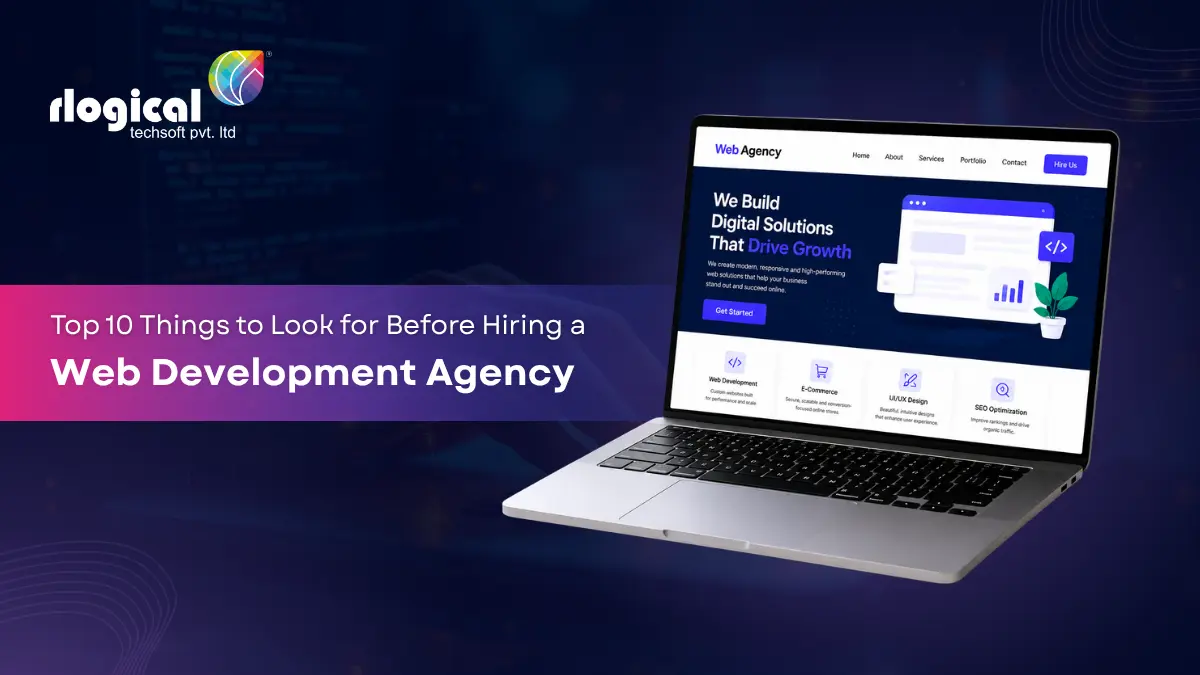
Choosing a web development agency is one of the more consequential decisions you will make for your business. A well-built website drives leads, supports sales, and builds trust with potential customers. A poorly built one does the opposite and can cost significantly more to fix than it would have cost to get right the first time.
This guide covers ten specific things to evaluate before you commit to an agency. These are practical checkpoints, not vague advice, so you can compare agencies with a clear head.
Whether you’re planning a new website or looking to scale an existing digital product, it’s helpful to understand what professional web development services typically include. You can explore more about web development solutions here: https://www.rlogical.com/web-development/
Before any code is written, a good agency wants to understand your business. Not just the website requirements, but the problem the website needs to solve and the audience it needs to reach.
During your first conversation, notice whether they ask about your goals, your competitors, or your existing traffic data. An agency that jumps straight to design options or pricing before asking these questions is working from assumptions, not understanding.
Ask them to walk you through their discovery process. Specifically:
Their answers will tell you a lot about how the project will actually run once you sign.
Most agencies will show you their best work. Your job is to look past the visuals and ask sharper questions.
Look at the industries they have served. If you are in manufacturing, an agency that has only built e-commerce sites for consumer brands may not understand the decision-making journey of a B2B buyer. That gap shows up in site structure, content hierarchy, and conversion design.
Check the live versions of portfolio sites, not just the screenshots. Verify that those sites load quickly, work properly on mobile, and feel well-structured. If a site they built three years ago is broken or slow today, that says something about how much they care about long-term quality.
Some agencies operate as project managers who outsource actual development to third parties. This is not always a problem, but it introduces risks around quality control, communication delays, and accountability when things go wrong.
Ask directly: who will write the code? Who handles design? Is any part of this project outsourced, and if so, to whom?
You want an agency where the core team is internal, even if they use contractors for specific tasks like copywriting or motion graphics. The more the critical technical work is handled in-house, the easier it is to maintain quality and resolve issues quickly.
The technology stack an agency recommends should match your actual needs, not their internal preferences or the tools they happen to know best.
A static brochure site has different requirements than a large e-commerce platform or a SaaS product with a customer portal. An agency recommending WordPress for every project regardless of scope, or pushing a custom-built CMS when an off-the-shelf solution would serve you better, is optimizing for their workflow rather than your business.
Ask them to explain why they are recommending a specific CMS, framework, or hosting setup. If they cannot explain the tradeoffs clearly, that is a signal worth noting.
Also ask about performance standards. Google uses Core Web Vitals as a ranking factor. A reputable agency should be able to tell you what Largest Contentful Paint, Cumulative Layout Shift, and Interaction to Next Paint mean and how they plan to meet targets for each.
A website that looks good but ranks poorly or loads slowly is not doing its job. Technical SEO and page speed should be built into the project from the start, not bolted on at the end.
Ask specifically:
Agencies that treat SEO as someone else’s responsibility are handing you a site with a structural disadvantage before it is even live.
Poor communication is the most common reason web projects run late or go over budget. Before you sign, get clarity on how the agency handles day-to-day project communication.
Find out who your main point of contact will be. Is it the same person who sold you the project, or will you be handed off to a project manager you have never spoken to? Will you have access to the developers if technical questions come up?
Also clarify:
A project with clear communication rhythms is far more likely to finish on time and to your satisfaction.
Security is not optional. A website that handles customer data, processes payments, or collects form submissions carries real risk if it is not built with proper safeguards.
Ask the agency how they handle:
If they use WordPress or another CMS with a plugin ecosystem, ask how they vet third-party plugins and how they handle security patches after launch. An agency with no clear security policy is a liability you do not want to inherit.
It is worth being explicit about who owns what when the project is complete. Some agencies retain control of domain names, hosting accounts, or source code unless you negotiate ownership upfront.
Before you sign any contract, confirm:
Your website is a business asset. You should have full access to it without depending on the agency to make changes or move it to a different provider. If an agency is unwilling to put this in writing, treat that as a serious warning sign.
The contract is where good intentions become actual commitments. Read it carefully and pay attention to:
Many agencies offer a short warranty period, typically 30 to 90 days, during which they will fix bugs or defects at no charge. Understand exactly what qualifies as a warranty item and what falls outside it.
Also look for an Annual Maintenance Contract (AMC) option if you want ongoing support beyond the warranty window. Clarify what that covers, what it costs, and what the response time commitment is.
A portfolio shows you what an agency has built. References tell you what it was like to work with them.
Ask the agency for two or three client contacts you can speak to directly. When you reach those clients, ask specific questions:
Also search for the agency on Google Business, Clutch, or G2. Look at the volume and recency of reviews, not just the star rating. A company with 40 reviews from the past two years tells a more reliable story than one with 5 reviews, all from four years ago.
If an agency cannot provide any references or if the only reviews you can find are vague and undated, that is worth pausing on.
Once you have narrowed your list to one or two agencies, these questions will help you make a final call:
The answers matter less for the information they contain and more for how openly and honestly the agency responds. A team that has thought carefully about these questions has probably built a process to deal with them.
If you’re evaluating agencies and want to understand the range of services available, you can explore Rlogical for an overview of web development solutions. Businesses that need dedicated technical resources can also review https://www.rlogical.com/hire-web-app-developer/ to learn more about hiring experienced web application developers.
Hiring the right web development agency comes down to three things: their technical ability, their process discipline, and how honest they are with you from the start.
A strong portfolio is a starting point, not a final answer. Dig into the process, ask uncomfortable questions, and get everything confirmed in a signed contract before the project begins.
The agencies worth working with will welcome this level of scrutiny. The ones that do not are telling you something important.
Jatin Panchal is an innovation-driven entrepreneur, and the Founder & Managing Director of Rlogical Techsoft Pvt. Ltd. He believes modern leadership is driven by innovation, adaptability, and the transformative power of Artificial Intelligence. He focuses on helping businesses accelerate digital growth through AI-powered solutions, intelligent automation, Cloud, blockchain, IoT, and scalable enterprise technologies. With a strong strategic vision and future-focused mindset, he is passionate about building technology ecosystems that improve efficiency, drive innovation, and create long-term business value for global clients.
Global insights on technology trends, best practices, and digital transformation strategies.
A proven track record of high-impact deliveries across industries and technologies
Share with us. We'll assess its feasibility, suggest the right tech stack, and share a clear cost & timeline.
Years of Experience
Projects
Countries
Engineers
Verified Client Reviews
Industry Served