

Share



Published on 19 November, 2025
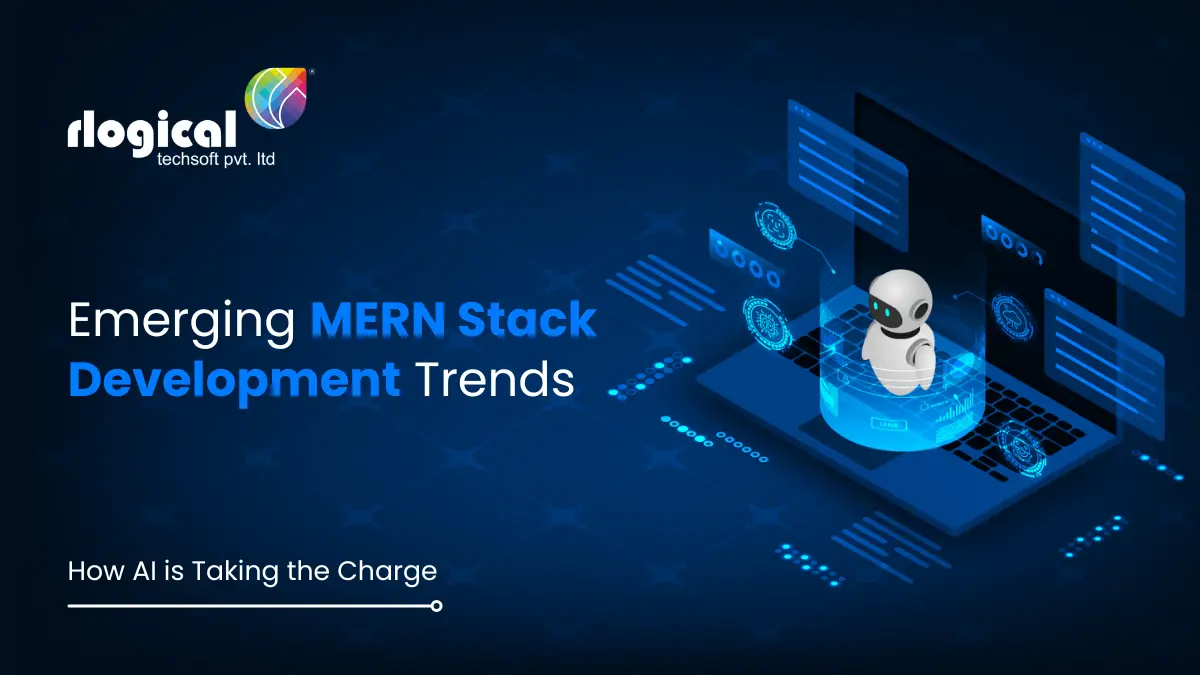
Quick Overview: AI-powered MERN Stack applications, the fresh and user-centric adaptation of MERN development. You can have the topmost features of AI and full stack tech both. AI in MERN Stack is bringing the legacy of automation during the development stages and even after the launch of applications. As the automated features are appealing to the user, your MERN stack application can open the doors to endless possibilities. Explore the details on the Integrating AI in MERN Stack & its trends.
As the digital landscape is becoming smarter and inclined towards emerging technologies. So, the MERN stack is evolving to meet modern expectations. In the upcoming years, the biggest advancements will revolve and amplify the capabilities of MongoDB, Express, React, and Node.js.
The bespoking trends are transforming MERN from a traditional full stack development tech into a future-ready ecosystem. So, it will enhance the capability of handling intelligent, real-time, and highly personalized applications. Here are the trends reshaping MERN Stack development.
AI is now the driving force behind modern web applications, and MERN provides the perfect structure to support these intelligent experiences. Nowadays, MERN stack developers are integrating machine learning models to build apps that respond, adapt, and predict user needs.
User behavior data is stored in MongoDB and later passed to AI pipelines. It is used for pattern detection, embedding generation, or real-time analytics. Moreover, it delivers personalized dashboards, recommendations, and content to optimize your application. These capabilities help businesses make smarter decisions and deliver faster. Consequently, it leads to more intuitive user journeys.
The serverless architecture is becoming a top trend as businesses look to reduce infrastructure costs. It even improves scalability and data storage seamlessly. Node.js integrates with serverless functions on AWS Lambda, Microsoft Azure, and Google Cloud. So, these functions can run AI pipelines such as image processing, chatbot responses, etc.
In serverless MERN architectures, the backend logic moves to cloud functions (AWS Lambda, Google Cloud Functions, Azure Functions). The React frontend communicates with these functions instead of a long-running Express server. Do you know? Netflix uses Node-based AWS Lambda functions to process media events.
The backend tasks like authentication, notifications, and AI development and processing are increasingly delegated to cloud services. Hence, it enables MERN developers to focus more on business logic and UI. Everything while maintaining a more seamless and cost-effective infrastructure.
Applications built on MERN are becoming more real-time and event-driven. Thanks to the growing demand for instant updates, industries like logistics, finance, and IoT use AI models in MERN to manage data. That, why MERN for startups has gotten a great push.
With this, it will analyze real-time data streams. React handles dynamic UI updates while Node + Express manages fast API delivery. And MongoDB handles the data processing with constantly updating records.
Additionally, the WebSockets enable real-time and two-way communication between client and server. So, this has been about combining this with AI, which adds predictive capabilities. Thus, it allows the forecasting of user actions, spotting anomalies, or suggesting next steps. It makes apps significantly more intelligent and proactive.
The MERN Stack is the most popular among the full-stack development technologies. As it has the appealing React framework and JavaScript-based efficacy. Aside from that, DevOps has seamless integration with tools like GitHub, Jenkins, Docker, and Kubernetes.
CI/CD pipelines automate testing and deployment for MERN applications using them. For example, Airbnb uses Kubernetes and CI/CD pipelines for Node.js microservices. Therefore, you will have the wholesome benefits of DevOps with the top-quality and continuous improvement of the application functionality. You can see that all the trends are directly or indirectly related to the AI basis. So, taking you into the depths of AI in MERN.
AI enhances automation and data-driven decision-making, but its reliability depends on model quality, training data, and production monitoring. For MERN stack development, the influence of AI has been segmented into both the development cycle and feature integration. Majorly, the AI in the MERN Stack refers to the integration of Artificial Intelligence capabilities into applications.
For a web app built using the MERN architecture, i.e., MongoDB, Express.js, React, and Node.js. So, the shift of AI is initially automation-based and leads to efficiency aspects. In simple terms, instead of relying only on traditional logic-based programming.
AI enables MERN applications to become smarter, adaptive, and data-driven. By embedding AI models, APIs, or machine learning features into MERN projects. Moreover, now the MERN stack developers have upskilled into AI and ML aspects. It can transform standard web apps into intelligent systems that can;
Diversifying the essence of AI into each MERN stack subtech aspect. This narrow-down representation will unveil the bigger picture benefits.
The AI enhances user interfaces by enabling smart search, personalization, chatbots, recommendations, and on-device ML using tools like TensorFlow.js.
Having the MERN stack Developers can host AI microservices, connect with AI APIs (OpenAI, Gemini, AWS AI). Additionally, Node acts as an orchestrator, calling external AI APIs or Python-based microservices accordingly. So, your backend will get a robust edge with AI efficiency. Check out the top apps built with NodeJs, it’s the classic powerhouse tech for a long time now.
MongoDB is used to store embeddings, behavior logs, and training datasets. While the actual analytics and AI inference happen in external services such as Python microservices, OpenAI APIs, or vector databases. So, MongoDB Atlas provides AI-friendly features such as vector search, full-text search, and real-time analytics.
These are not part of the MongoDB Community Edition but are available through Atlas cloud services. Spotify has been a correct use case example of this. It uses MongoDB Atlas for user personalization and recommendation ranking using vector search.
Integrating AI into a MERN application isn’t just about making the app fancy. It keeps on adding real intelligence where it creates value. The better recommendations, smarter search, faster support, or richer analytics. Here’s a practical, no-fluff way to think about it.
Before touching code, define what AI should do in your MERN app:
Therefore, a clear use case will drive every architectural and technical decision. AI integration from the beginning follows the supremacy of the overall impact on the quality and performance factors.
There are diverse ways of using AI in your MERN stack app. However, the effective and your project-based are typically three options;
AI via external APIs
Self-hosted or custom models (Python/ML stack)
Pre-built AI services (search, vision, speech, etc.)
A simple and robust pattern looks like this:
Hence, this keeps AI logic behind the backend, never directly from the browser. Although it is critical for security and key management.
At the Node/Express layer, you typically:
This layer is also where you:
On the React side, you have to trigger API calls via fetch or axios from components or hooks. So, this shows:
Well, you can also;
AI in production is not “set it and forget it.” You should;
Log:
Store these in MongoDB collections for:
Hence, this gives you a feedback loop to continuously refine prompts, rules, or even models. Having a reliable AI service provider for your business will enhance the proficiency of your software.
When AI is part of an MERN app, your application can gain the following edge:
Moreover, there are a few challenges you might face while integrating AI into the MERN stack, as under…
It’s evident that deploying AI models within MERN apps can strain server resources. So, hosting large models often requires specialized infrastructure. Accordingly, latency can become a bottleneck, especially for real-time applications.
The training of custom AI models demands significant computational power and appropriate time. Fine-tuning even pre-trained models can bring budget constraints for smaller teams. So, you need well-trained resources for making everything fit under budget.
Pro Tip: Hire MERN Stack Developers from Rlogical and make your project fall within your planned budget.
Integrating AI introduces new attack surfaces for your MERN Stack application. The models can be vulnerable to a diverse extent. It can lead to adversarial inputs, data leaks, or misuse if not properly secured. So, protecting user data and model integrity becomes a top priority.
The AI predictions are only as good as the data and training behind them. So, there may arise the issue of inaccurate outputs of a degraded user experience. Hence, continuous monitoring and validation are essential to maintain trust and retain customers. However, the limitations can be manageable if you have a reliable MERN Stack Development company. Ignoring AI will let you fall behind in the future market race!
The MERN stack—MongoDB, Express.js, React, and Node.js—is becoming a fertile ground for AI-driven innovation. Probably, from the intelligent agents to autonomous applications, the fusion of AI and MERN is remarkably great. It unlocks the faster, smarter, and more adaptive MERN Stack development workflows. So, here’s a deep dive into the most promising future of AI-driven features for MERN applications.
The Large Language Models (LLMs) like GPT and Claude are no longer just tools for chatbots. They’re becoming integral to full-stack development services. AI agents embedded in web apps can handle dynamic user interactions, automate support. It even personalizes content in real time.
Additionally, the Automated coding, UI generation, and content creation are streamlining development, allowing teams to prototype and iterate faster than ever. The cherry on the cake is that Developers can now co-create with AI. Moreover, they can turn natural language prompts into functional React components.
AI-powered MERN Stack Applications are not just developer-friendly but have a future-ready scope. Your business adopting AI+MERN gains speed, intelligence, and a competitive edge. As every business is turning towards AI and ML opportunities, your existing software even needs this promising tech expertise. From integrating AI in MERN Stack projects to developing enterprise solutions, Rlogical Techsoft is the best-in-class partner for you!
The AI is enhancing the MERN stack with better efficiency, automation, and speedy processes. Your MERN Stack AI Development will be harnessed with smart and secure functionality.
The AI MERN Stack development cost is thoroughly dependent on your use case and industry dynamics. It will narrow down your requirements for the technology stack, which will increase or decrease the price. Moreover, the minimal MERN Stack project with AI edge starts from $10,000.
Rahul Panchal is a visionary technology entrepreneur and the Founder & Managing Director of Rlogical Techsoft Pvt. Ltd. Passionate about the power of Artificial Intelligence, he focuses on helping businesses transform through AI-driven solutions, intelligent automation, and data-centric digital ecosystems. Alongside AI, his expertise spans scalable web and mobile platforms, Cloud, IoT, and modern enterprise technologies enabling organizations to innovate faster, optimize operations, and build future-ready digital products with real business impact.
Global insights on technology trends, best practices, and digital transformation strategies.
A proven track record of high-impact deliveries across industries and technologies
Share with us. We'll assess its feasibility, suggest the right tech stack, and share a clear cost & timeline.
Years of Experience
Projects
Countries
Engineers
Verified Client Reviews
Industry Served