

Share



Published on 11 February, 2026
| Last Updated on 18 February, 2026
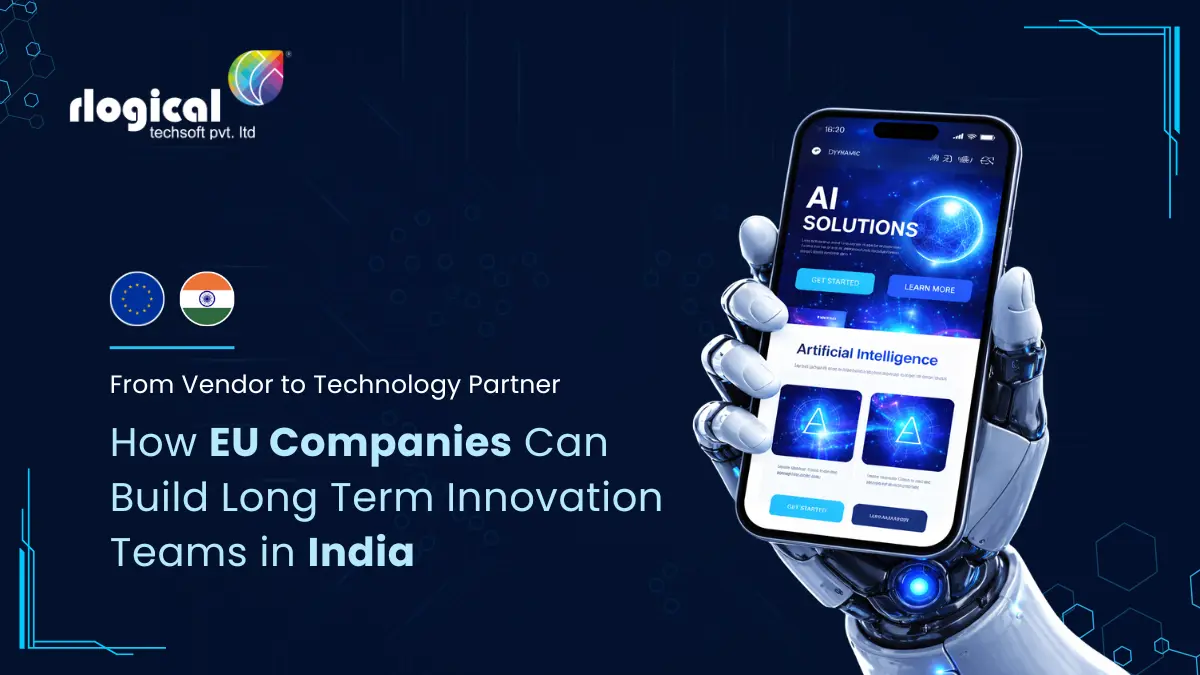
European businesses are under pressure to innovate faster, control development costs, and stay compliant with strict regulatory standards. At the same time, the EU continues to face a structural shortage of senior software engineers, cloud architects, AI specialists, and cybersecurity professionals.
India has long been a global technology powerhouse. With the evolving India EU trade agreement framework and stronger cooperation between European Union and India, software outsourcing is becoming more structured, predictable, and strategically aligned.
For EU companies, this is no longer about finding a low cost vendor. It is about building long term innovation teams in India that operate as an extension of your core engineering organization.
This guide explains how to do that successfully and why now is the right time.
If you are looking to build a scalable and reliable engineering team in India, you can explore the full details at https://www.rlogical.com/hire-dedicated-developers/
The old outsourcing model focused on cost arbitrage. It created transactional relationships with limited ownership, weak collaboration, and inconsistent quality.
Today, EU decision makers care about:
The India EU trade discussions have reinforced services cooperation, digital trade alignment, and professional mobility frameworks. This creates greater predictability in cross-border service delivery and reduces regulatory uncertainty for EU companies working with Indian partners.
The result is a shift from short term vendor contracts to strategic technology partnerships.
While the full trade framework continues to evolve, several structural impacts are already clear.
The agreement prioritizes services trade, including IT, digital services, consulting, and R and D collaboration. This strengthens the legal and commercial foundation for long term software partnerships.
For EU companies, this means:
Professional mobility discussions within the trade deal framework support smoother temporary movement of skilled professionals for onsite collaboration, workshops, audits, and integration phases.
This makes hybrid delivery models more practical, where strategic workshops can happen in the EU while core engineering continues from India.
As digital trade becomes central to EU India economic relations, companies that operate with strong data governance and security frameworks will benefit the most.
For EU organizations, outsourcing to a structured Indian partner becomes easier when compliance expectations are clearly defined at a bilateral level.
Building a long term innovation team in India requires a structural approach.
Look for:
Rlogical focuses on structured delivery models that align with EU compliance and enterprise-grade expectations. To explore how this approach can support your organization, visit https://www.rlogical.com/contact/
Instead of project based outsourcing, build a dedicated engineering team that:
This model creates accountability, continuity, and innovation.
High performing EU India partnerships align early on:
When technical alignment is strong, geographical distance becomes irrelevant.
India offers structural advantages that go beyond cost.
India produces one of the largest numbers of engineering graduates globally. The ecosystem is mature across:
Indian software professionals operate comfortably in English and have decades of experience working with EU and US clients using Agile and Scrum frameworks.
There is meaningful working hour overlap between India and Central Europe. This allows daily collaboration while also enabling extended development cycles.
European companies must ensure strict compliance with GDPR and other data protection regulations.
When outsourcing to India, this requires:
Rlogical integrates compliance considerations directly into its development lifecycle. Security is not an afterthought. It is embedded in architecture design, sprint planning, and deployment.
Thanks to stronger EU-India economic cooperation:
This reduces friction in cross border service delivery.
For EU CTOs and founders, this means lower perceived risk and greater long-term stability when building teams in India.
The future of software development is collaborative.
EU companies bring:
Indian innovation teams bring:
Together, they create resilient, competitive digital businesses.
The companies that win in the next decade will not simply outsource. They will build integrated global engineering ecosystems.
The evolving trade relationship between the European Union and India is strengthening the foundation for digital collaboration. For EU companies, this is an opportunity to rethink outsourcing as strategic innovation building.
By choosing a structured, compliance-aware, and engineering-focused partner like Rlogical, you can transform offshore development into a long term competitive advantage.
If your goal is to build a secure, scalable, and innovation-driven engineering team in India, now is the right time to move from vendor relationships to technology partnerships.
Yes, outsourcing to India is secure when working with a compliance focused partner. EU companies must ensure GDPR alignment, data protection agreements, secure DevOps practices, and strong IP protection. Established Indian firms like Rlogical integrate security and compliance into their development lifecycle.
The evolving India EU trade framework strengthens services trade, digital cooperation, and professional mobility. This reduces regulatory uncertainty and creates a more predictable legal environment for EU companies outsourcing software development to India.
India offers a larger engineering talent pool, strong English proficiency, competitive cost structures, and deep expertise in AI, cloud, SaaS, and fintech. For long term scalability, India provides greater capacity compared to smaller regional markets.
EU companies should implement Data Processing Agreements, restrict data access, enforce encrypted communication, and conduct regular security audits. A mature outsourcing partner will provide documented compliance frameworks and secure infrastructure policies.
A vendor typically delivers short-term, project-based work. A technology partner builds a dedicated engineering team, aligns with long term product strategy, follows shared KPIs, and participates in continuous innovation. This model provides better scalability and product ownership.
Rahul Panchal is a visionary technology entrepreneur and the Founder & Managing Director of Rlogical Techsoft Pvt. Ltd. Passionate about the power of Artificial Intelligence, he focuses on helping businesses transform through AI-driven solutions, intelligent automation, and data-centric digital ecosystems. Alongside AI, his expertise spans scalable web and mobile platforms, Cloud, IoT, and modern enterprise technologies enabling organizations to innovate faster, optimize operations, and build future-ready digital products with real business impact.
Global insights on technology trends, best practices, and digital transformation strategies.
A proven track record of high-impact deliveries across industries and technologies
Share with us. We'll assess its feasibility, suggest the right tech stack, and share a clear cost & timeline.
Years of Experience
Projects
Countries
Engineers
Verified Client Reviews
Industry Served