



Share



Published on 26 October, 2018
| Last Updated on 18 May, 2026
React Native has changed how teams build mobile apps. But with the New Architecture now stable, AI integration on the rise, and serious competition from Flutter, does it still lead cross-platform mobile development in 2026? Short answer: yes, and here is why.
React Native is an open-source JavaScript framework created by Meta (formerly Facebook) in 2015. It lets developers write code once in JavaScript and ship working apps to both iOS and Android, using actual native components rather than a web view wrapper.
That distinction matters. Unlike hybrid frameworks that render inside a browser shell, React Native maps JavaScript components directly to native platform elements. The result is an app that looks, feels, and performs like a native product.
Today, React Native powers apps at Meta, Microsoft, Shopify, Tesla, and Discord. It has over 120,000 GitHub stars and a growing contributor base, making it one of the most widely adopted mobile frameworks available.
Cross-platform development has matured. A few years ago, choosing it over native was considered a compromise. Today, it is often the default choice for product teams that need speed, code reuse, and lower overhead.

Source: Intel Market Research, 2024 React Native App Development Market Report.
For startups validating a product idea and for enterprises managing multiple apps at once, those advantages are real and measurable. Many companies also choose to hire React Native developers to accelerate cross-platform delivery without doubling engineering costs.
For years, React Native’s biggest criticism was its reliance on a JavaScript bridge. Every time the app needed to communicate with native code, data had to be serialized to JSON, sent across a bridge thread, and deserialized on the other side. At scale, this created performance bottlenecks.
The New Architecture, enabled by default in new React Native projects as of 2025, replaces that bridge entirely with three core components.
JSI is a lightweight C++ layer that lets JavaScript and native code share values and call functions directly, with no JSON serialization required. This cuts latency significantly for any operation that crosses the JS-to-native boundary.
TurboModules replace the old NativeModules system with lazy-loaded, type-safe native modules. Instead of loading everything at startup, only the modules the app actually needs are initialized on demand. According to production benchmarks, apps with 20 or more native modules see startup time reductions of 25 to 40 percent from this change alone.
Fabric is the new rendering engine. It supports concurrent rendering, meaning UI updates can be prioritized and handled more smoothly. Combined with fewer layout passes and reduced main-thread blocking, Fabric makes animations and gesture handling feel noticeably more responsive.

Hermes is the default JavaScript engine for React Native. It is purpose-built for mobile, with faster startup times, lower memory consumption, and tight integration with JSI. It also improves the runtime efficiency of on-device AI workloads, which matters as more apps incorporate machine-learning features.
AI is no longer a feature you add after launch. It is becoming part of the core product experience, and React Native is adapting to support it directly.
Developers who combine React Native skills with AI API knowledge are seeing stronger project demand. This combination is becoming a meaningful differentiator in the mobile development market.
React Native is no longer just a mobile framework. Its reach now extends to multiple platforms from a single codebase.
For companies that operate across web, mobile, and desktop, this level of code sharing is a real operational advantage. Expo Router, with its file-based navigation structure similar to Next.js, makes managing multi-platform projects significantly more predictable.
Flutter is the most serious competition React Native faces. Both are mature, production-ready frameworks. Choosing between them depends more on team context than on which framework is objectively superior.
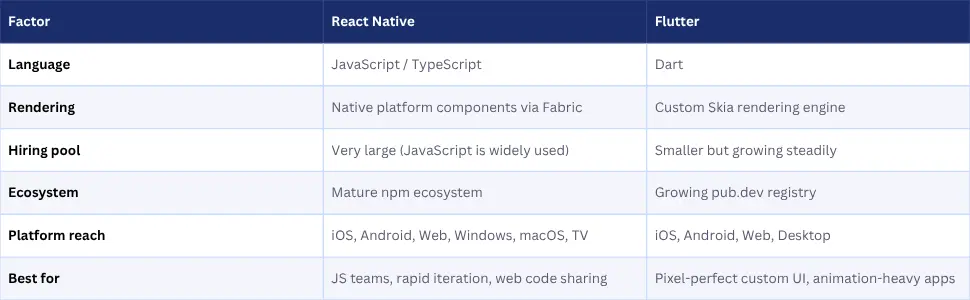
For teams already working in JavaScript or TypeScript, React Native is the natural fit. Flutter has an edge in highly custom visual experiences where pixel-level control matters. Both frameworks are strong choices for most production applications.
React Native performs best in specific scenarios. Understanding where it shines prevents the frustration of using it where a different approach would serve better.
Businesses planning large-scale digital products often prefer to hire mobile app developers with cross-platform experience to reduce maintenance complexity and improve release speed.
React Native is less suited to apps that rely on heavy 3D graphics, complex game engines, or very deep integration with platform-specific APIs. In those cases, native development or a specialized engine is the better path.
React Native’s roadmap through 2025 and into 2026 focuses on completing the New Architecture rollout, deepening integration with React 19, and stabilizing support for Windows and macOS as production-grade targets.
A few trends worth watching:
The framework is not standing still. Meta, Microsoft, Shopify, and Expo all invest actively in its development. That breadth of support from large production users is a meaningful indicator of its long-term trajectory.
React Native in 2026 is a materially better framework than it was three years ago. The New Architecture resolves the performance limitations that shaped its reputation for years. JSI, TurboModules, and the Fabric renderer bring it close to native performance on the metrics that matter most to real users.
It is not the right choice for every project. But for teams building cross-platform apps that need to move fast, share code, and reach users on both iOS and Android without doubling development effort, React Native remains one of the most practical and production-proven options available.
Its continued evolution, enterprise adoption, and growing role in full-stack JavaScript development make it a framework worth investing in for mobile projects in 2025 and beyond.

Jatin Panchal is an innovation-driven entrepreneur, and the Founder & Managing Director of Rlogical Techsoft Pvt. Ltd. He believes modern leadership is driven by innovation, adaptability, and the transformative power of Artificial Intelligence. He focuses on helping businesses accelerate digital growth through AI-powered solutions, intelligent automation, Cloud, blockchain, IoT, and scalable enterprise technologies. With a strong strategic vision and future-focused mindset, he is passionate about building technology ecosystems that improve efficiency, drive innovation, and create long-term business value for global clients.
Global insights on technology trends, best practices, and digital transformation strategies.
A proven track record of high-impact deliveries across industries and technologies
Share with us. We'll assess its feasibility, suggest the right tech stack, and share a clear cost & timeline.
Years of Experience
Projects
Countries
Engineers
Verified Client Reviews
Industry Served