Share



Published on 03 November, 2018
| Last Updated on 03 June, 2026
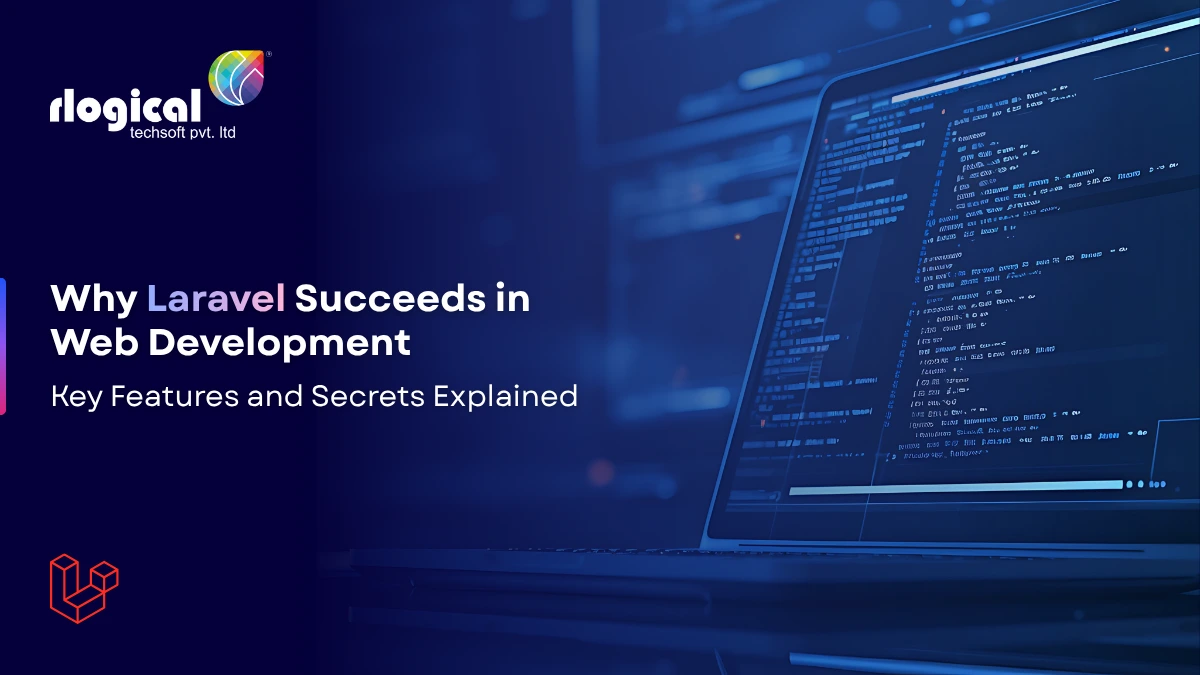
Choosing a PHP framework is not a decision developers take lightly. The framework you pick will shape your project structure, affect team productivity, and determine how easily the application scales over time.
Laravel has consistently ranked as one of the most popular PHP frameworks over the past decade, and for good reason. It offers a thoughtful architecture, an expressive syntax, and a rich ecosystem of first-party packages that solve real-world problems out of the box.
This article walks through the core features that make Laravel development successful, updated to reflect what the framework looks like today with Laravel 12.
Laravel is a free, open-source PHP framework created by Taylor Otwell in 2011. It follows the Model-View-Controller (MVC) architectural pattern, which separates business logic from presentation and makes large codebases far easier to maintain.
As of early 2025, Laravel 12 is the current major release. It requires PHP 8.2 or higher and ships with updated starter kits for React, Vue, and Livewire. The framework now also includes first-party support for building AI-powered features through the Laravel MCP library, announced at Laracon US 2025.
There are plenty of PHP frameworks available, including Symfony, CodeIgniter, and Yii. Laravel stands apart for a specific set of reasons that matter in day-to-day development.
Many businesses today prefer Laravel because it balances development speed with long-term maintainability. It is especially useful for companies building scalable web applications, SaaS products, and enterprise platforms that rely on modern PHP technologies. Developers working on complex applications often choose frameworks that simplify workflows while still supporting customization and performance. You can explore more about enterprise-level PHP solutions here: https://www.rlogical.com/php-development/
It reduces boilerplate code without sacrificing control. It has a predictable directory structure that new team members can pick up quickly. And its documentation is thorough, actively maintained, and written for developers at every skill level.
Below is a detailed look at the features that make Laravel worth using on your next project.
Laravel ships with a well-thought-out directory layout. Application code sits in the app/ directory, routes are defined in the routes/ folder, and configuration files are centralized under config/. This makes it easier for teams to collaborate without stepping on each other’s work.
Unlike older PHP projects where file organization was left entirely to the developer, Laravel enforces a consistent structure from the start. This pays off significantly as applications grow beyond a few hundred files.
Laravel’s IoC (Inversion of Control) container handles dependency injection automatically. When a class or method declares a type-hinted dependency, Laravel resolves it without you writing the wiring code manually.
This approach keeps controllers lean and makes code testable. You can swap real implementations for mock objects in unit tests without changing the class itself. For teams following SOLID principles, this is one of Laravel’s most practical advantages.
Laravel Contracts are a set of PHP interfaces that define the core services the framework provides, covering areas like caching, queues, mail, and file storage. Programming against contracts rather than concrete implementations keeps application code flexible.
If you later switch from Redis to a different cache driver, your application code does not need to change because it only depends on the contract. This is particularly useful in large projects where the underlying infrastructure may evolve independently of the application logic.
For applications with hundreds of routes, every request would normally require Laravel to parse and register each one. Route caching compiles all route definitions into a single cached file that loads significantly faster.
You enable it with a single Artisan command:
php artisan route:cache
This is a standard step in any Laravel production deployment. It is worth noting that route caching requires all route closures to be replaced with controller methods, which is considered good practice regardless.
Authentication is one of the most error-prone parts of web development. Laravel handles the heavy lifting through its built-in Auth system, and provides starter kits that scaffold login, registration, email verification, and password reset workflows.
The framework also includes a Gates and Policies system for authorization. Gates handle simple permission checks, while Policies group authorization logic for a specific model. Together, they cover most access control scenarios without needing a third-party package.
Laravel Sanctum covers API token authentication for SPAs and mobile clients. Laravel Passport adds full OAuth2 server capabilities for applications that need it.
Laravel’s event system lets different parts of your application communicate without being tightly coupled. When something significant happens in your application, such as a new user registering or an order being placed, you fire an event. Any number of listeners can respond to that event independently.
This pattern keeps controllers focused on their primary task. Sending a welcome email, updating analytics, or triggering a webhook on user registration become listener responsibilities, not controller concerns. The result is code that is easier to test and extend.
Laravel’s Filesystem abstraction, built on the Flysystem library, lets you interact with local disk, Amazon S3, and other cloud storage providers through a single, consistent API. Switching storage backends requires a configuration change, not a code rewrite.
This is useful during development, where you store files locally, and in production, where you point the same code at an S3 bucket. Teams that need to migrate storage providers later can do so without touching their upload logic.
Artisan is Laravel’s command-line interface. It automates repetitive development tasks like generating controllers, models, migrations, and jobs. You can also write custom Artisan commands specific to your application, which makes scripting maintenance tasks straightforward.
Eloquent is Laravel’s active record ORM. Each database table maps to a model class, and relationships between tables are defined as methods on those models. Querying a user with their related orders, or filtering results with readable method chaining, requires far less SQL knowledge than working with raw queries.
Blade is Laravel’s built-in template engine. It allows you to write clean HTML with embedded PHP directives like @if, @foreach, and @extends. Blade compiles to plain PHP and caches the output, so there is no runtime overhead compared to writing raw PHP templates.
Laravel includes CSRF protection on all forms by default through the @csrf Blade directive. It also escapes output in templates to prevent XSS attacks, and its password hashing uses bcrypt or Argon2 by default. These defaults protect applications from the most common web vulnerabilities without requiring any additional configuration.
Laravel is built with testing in mind. It ships with PHPUnit integration and a custom testing API that lets you write HTTP tests, database assertions, and queue assertions in plain PHP. Laravel Dusk adds browser automation testing for JavaScript-heavy interfaces.
Laravel 12, released in early 2025, continues the framework’s annual release cycle. It requires PHP 8.2 or higher and focuses on developer experience, performance, and long-term maintainability. Key additions include:
The Laravel release schedule also follows semantic versioning with a yearly major release cadence. Bug fixes are supported for 18 months and security fixes for 2 years after each major release, giving teams predictable upgrade windows.
Laravel is a strong fit for projects that need a complete solution from day one. This includes SaaS platforms, e-commerce applications, internal business tools, content management systems, and API backends that serve mobile or JavaScript front ends.
It is also a practical choice for teams that want to maintain a consistent codebase across multiple projects, since the framework’s conventions carry over regardless of what you are building.
If your team is evaluating PHP frameworks for a new project, Laravel’s combination of developer tooling, security defaults, and ecosystem maturity makes it a reliable starting point.
When evaluating backend technologies for enterprise or long-term projects, teams also compare Laravel with other development platforms to understand differences in performance, scalability, and maintenance requirements. https://www.rlogical.com/blog/php-vs-asp-net-which-is-better-to-opt/
Laravel’s success in web development comes down to a deliberate set of design decisions. From its structured directory layout and IoC container to its built-in security features and unified filesystem API, each part of the framework exists to reduce friction for developers without limiting what they can build.
With Laravel 12 pushing into AI tooling, faster caching, and a managed cloud platform, the framework continues to evolve alongside the industry. For teams looking to build reliable, maintainable PHP applications, it remains one of the most capable options available today.
Choosing the right framework ultimately depends on your project goals, scalability expectations, and development roadmap. Teams planning custom Laravel applications or migrations often benefit from discussing technical requirements with experienced developers before starting implementation. If you want professional guidance for your next project, you can connect with the team here: https://www.rlogical.com/contact/
Jatin Panchal is an innovation-driven entrepreneur, and the Founder & Managing Director of Rlogical Techsoft Pvt. Ltd. He believes modern leadership is driven by innovation, adaptability, and the transformative power of Artificial Intelligence. He focuses on helping businesses accelerate digital growth through AI-powered solutions, intelligent automation, Cloud, blockchain, IoT, and scalable enterprise technologies. With a strong strategic vision and future-focused mindset, he is passionate about building technology ecosystems that improve efficiency, drive innovation, and create long-term business value for global clients.
Global insights on technology trends, best practices, and digital transformation strategies.
A proven track record of high-impact deliveries across industries and technologies
Share with us. We'll assess its feasibility, suggest the right tech stack, and share a clear cost & timeline.
Years of Experience
Projects
Countries
Engineers
Verified Client Reviews
Industry Served